
Affiliate disclosure: CompactBrew.com is a participant in the Amazon Associates Program. If you buy through links in this guide, we may earn a commission at no extra cost to you. Recommendations below are based on verified specifications and published reviews — not commission rates — and every price was checked during research in October 2026. Prices change often, so confirm the current figure before you buy. We follow the FTC’s Endorsement Guides, which require clear disclosure of material connections like affiliate relationships, close to the recommendation itself.
Buying a coffee maker for a small kitchen is a four-way balancing act: price, counter space, convenience, and coffee quality. The best budget coffee makers for small kitchens aren’t always the smallest or the cheapest — they’re the ones whose real dimensions fit your counter, whose capacity matches your mug count, and whose ongoing costs won’t surprise you three months in.
This guide is research-based, not a hands-on lab test. We verified specifications against official manufacturer pages, cross-checked prices at major retailers, and read published reviews from independent outlets. Where sources disagree — and they often do on budget machines — we flag it rather than guess. We also reviewed competing guides to make sure this one adds something: honest budget tiers, real dimensions, cabinet-clearance math, and total cost of ownership.
Quick Comparison: Best Budget Coffee Makers for Small Kitchens
| Product | Best for | Price verified (Oct 2026)* | Dimensions (W × D × H) | Brewing type | Main advantage | Main drawback |
|---|---|---|---|---|---|---|
| Elite Gourmet EHC4128 | Dorms, absolute minimum budget | $15.99 (maker’s store) | ~9″ × 8″ × 6″ [verify] | Drip, 4 cups | Cheapest verified; reusable filter included | No auto shut-off |
| Mr. Coffee 5-Cup Mini Brew | First apartment, two-mug mornings | ~$25–30 street | 6.4″ × 8.8″ × 10″ (official) [conflicts with retailers] | Drip, 25 oz | Grab-a-Cup Auto Pause; trusted brand | No timer or auto shut-off |
| KRUPS Simply Brew Compact 5-Cup | Small households who want looks + value | $34.99 MSRP | 5.7″ × 8.1″ × 10.1″ | Drip, 25 oz | Stainless design; 2-year warranty; permanent filter | No auto shut-off |
| AeroPress Go | Zero permanent counter space | $49.95 (maker’s list) | 3.6″ × 3.6″ × 4.5″ packed | Manual, 8 oz | Stores in a drawer; best flavor per dollar | Fully manual; one cup at a time |
| Keurig K-Mini | Narrowest possible powered footprint | 99.99list; 99.99 list; ~75–80 street | 4.5″ × 11.3″ × 12.1″ (16.8″ open) | K-Cup pod, 6–12 oz | 4.5″ wide; dead simple | Refill water every cup; pods cost more |
*Prices verified during research in October 2026. Street prices move weekly — confirm before publishing affiliate links. Items marked [verify] have conflicting sources and are listed in the final verification checklist at the end of this article.
Want a wider field? Our guide to the best compact coffee makers for small kitchens covers pod machines, SCA-certified brewers, and premium options beyond a strict budget.
The Best Budget Coffee Makers for Small Kitchens: Individual Reviews
1. Elite Gourmet EHC4128 — Best Under $150
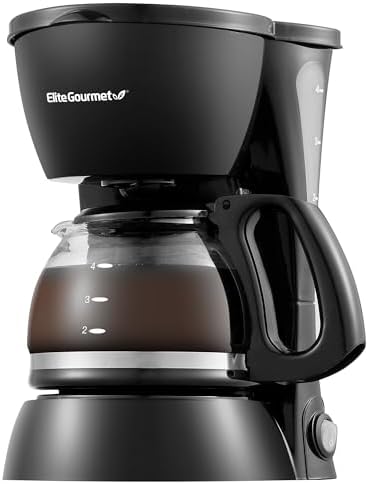
- 1 case of 8 Packs, 8 Count Total
- SEMI-TRANSPARENT WATER RESERVOIR holds up to 4 cups of water capacity with a level indicator to always ensure you have e…
- 4 CUP GLASS CARAFE for brewing the perfect quantity of hot fresh coffee for an individual or a small group of people.
Best for: students, dorm desks, office kitchens, and anyone whose budget is the hardest constraint.
Verdict: The cheapest coffee maker we could verify that is still a real drip machine with a glass carafe — not a novelty gadget.
Price verified: $15.99 on Elite Gourmet’s own store (shopelitegourmet.com), October 2026. Third-party marketplace listings vary.
Dimensions and capacity: Retail listings consistently show roughly 9″ W × 8″ D × 6″ H — notably short, so it slides under virtually any cabinet — with a 4-cup glass carafe (about 20 oz, or one generous 12-oz mug plus a refill). Elite Gourmet’s own page confirms the model number and feature list but not full dimensions, so treat the numbers as retailer-sourced.
Important features: Pause ‘N Serve (pour mid-brew), reusable filter (no paper filters to buy), keep-warm plate, semi-transparent water reservoir with level marks, simple on/off switch.
Advantages
- Lowest verified price of any machine in this guide — roughly the cost of four coffee-shop lattes.
- The included reusable filter removes the main recurring cost of drip brewing.
- At ~6 inches tall, it’s the only pick here with zero cabinet-clearance risk.
Disadvantages
- No auto shut-off. The keep-warm plate stays on until you flip the switch — a real consideration for dorms and busy mornings.
- 4-cup capacity is one-person territory.
- Build quality matches the price; think “solid for two years,” not “buy it for life.”
Cleaning and ongoing costs: Rinse the reusable filter and wash the carafe after each use; run a vinegar descale every month or two depending on water hardness. Ongoing cost is essentially just coffee.
Who should buy it: A solo drinker, a student outfitting a dorm, or an office that needs a functional pot at the lowest possible price.
Who should avoid it: Anyone brewing for two or more people daily, or anyone who needs programmable auto-brew.
Check the Elite Gourmet EHC4128’s current price and listing details before buying — and if you need a slightly bigger pot for a few dollars more, the Mr. Coffee below is the next step up.
Also read:https://compactbrew.com/best-compact-coffee-makers-under-200/
2. Mr. Coffee 5-Cup Mini Brew — Best Budget Drip for One or Two

- Please refer to user guide or user manual or user guide (provided below in PDF) before first use
- Grab-a-Cup Auto Pause lets you grab a cup before brewing is finished
- Lift & Clean Filter Basket makes for easy cleanup
Best for: first apartments, couples who share a morning pot, and buyers who want a name-brand machine with replacement parts everywhere.
Verdict: The default answer to “what’s a good cheap coffee maker under $50?” for ground-coffee drinkers — simple, compact, and proven at massive scale.
Price verified: Widely listed around $25–30 at major retailers in October 2026 (one major marketplace listing showed $28.99). [Flagged for final verification.]
Dimensions and capacity: Per Mr. Coffee’s official product page, the machine makes 25 oz (two 12-oz cups), measures 8.8″ L × 6.4″ W × 10″ H, and weighs 3.15 lb. Note: many retailer listings show different dimensions (~10.7″ deep × 9.8″ wide), so measure your gap with margin. The official listing we accessed was marked final sale, which suggests the maker’s site configuration is in flux — availability at retailers remains strong, but re-confirm before linking.
Important features: Grab-a-Cup Auto Pause (pour mid-brew), Lift & Clean filter basket for easy grounds disposal, easy-view water window, ounce-marked ergonomic carafe, 1-year limited warranty, 24-inch cord.
Advantages
- One-switch operation; genuinely hard to fumble before coffee.
- Grab-a-Cup Auto Pause is the feature you’ll actually use every morning.
- Paper filters are cheap, and the basket accepts a reusable filter if you prefer.
Disadvantages
- No programmable timer and no auto shut-off on the Switch version — you must remember to flip it off.
- All-plastic build reflects the price point.
- The stock basket can overflow with standard filters at full capacity, per recurring owner reviews; a reusable filter or careful grounds dosing helps.
Cleaning and ongoing costs: Lift & Clean basket rinses in seconds; hand-wash the carafe. Descale with vinegar on a regular schedule. Ongoing costs: paper basket filters (or one reusable filter) plus ground coffee — the cheapest per-cup option in this guide.
Who should buy it: One or two people drinking ground coffee who want the most proven machine at the lowest price. Also a natural fit for our roundup of the best small drip coffee makers if you want to compare full-size small-batch brewers.
Who should avoid it: Households of three or more, or anyone who wants wake-up-ready programming (Mr. Coffee’s Programmable Mini Brew variant adds a Brew Later timer and 2-hour auto shut-off for a small premium — see our best compact coffee makers under $50 for that pick).
If a simple, proven two-cup drip machine fits your counter, check the Mr. Coffee Mini Brew’s current price — it’s rarely the wrong answer at this price.
also read:https://compactbrew.com/best-compact-coffee-makers-under-50/
3. KRUPS Simply Brew Compact 5-Cup — Best-Looking Budget Drip

- Compact Design: The coffee machine is great for small kitchens or offices this coffee maker brews just the right amount …
- Pause & Brew Function: Enjoy the flexibility to pour a cup mid-brew without a mess with the small drip coffee maker. Thi…
- Keep Warm Feature: Maintain your coffee at the optimal temperature for up to 30 minutes after brewing with this compact …
Best for: small households whose coffee maker sits in plain sight and should look like it belongs there.
Verdict: The most grown-up-looking machine under $40, with a longer warranty than anything else in its price range.
Price verified: $34.99 MSRP (KRUPS USA), with street prices typically between $34.99 and $45 depending on retailer.
Dimensions and capacity: 5.7″ W × 8.1″ D × 10.1″ H — a footprint of about 46 square inches, roughly half a sheet of paper — brewing 25 oz (5 five-ounce cups, or two real mugs).
Important features: Stainless steel and black exterior, Pause & Brew mid-cycle pouring, 30-minute keep-warm, permanent reusable filter and measuring spoon included, dishwasher-safe carafe and filter per KRUPS, 2-year warranty.
Advantages
- Looks noticeably more premium than plastic-bodied rivals at the same price.
- The included permanent filter means zero recurring filter costs.
- The 2-year warranty is the longest of any electric machine in this guide.
Disadvantages
- No auto shut-off — the hot plate runs until you switch it off.
- Keep-warm lasts 30 minutes only; slow drinkers will reheat.
- Top-fill reservoir needs a couple of inches of clearance above, so it’s better on an open counter than under low cabinets.
Cleaning and ongoing costs: Dishwasher-safe carafe and filter; descale every 1–3 months depending on water hardness. Ongoing cost is ground coffee only.
Who should buy it: Couples and singles who want ground coffee, a compact footprint, and an appliance that looks intentional on a visible counter.
Who should avoid it: Anyone who regularly forgets appliances are on (no auto shut-off), or anyone who nurses coffee for an hour.
For a stainless machine with a real warranty at a budget price, check the current KRUPS Simply Brew listing — and compare it side by side in our best compact coffee makers under $50 guide.
also read:https://compactbrew.com/best-compact-espresso-machines-small-kitchens/
4. AeroPress Go — Best for Zero Counter Space

- Compact Travel Coffee System – Brew smooth, rich coffee anywhere in under 2 minutes. Includes a small, portable version …
- A New Standard in Coffee Flavor – Equal parts French press, pour-over, and espresso, AeroPress patented 3 in 1 technolog…
- The Secret to AeroPress Superior Flavor – Air Pressure and micro-filtration work together to speed up extraction for les…
Best for: studio apartments, dorms, RVs, and anyone whose counter space is measured in single digits — or zero.
Verdict: The best flavor-per-dollar in this entire guide, and the only pick that takes up no permanent counter space at all.
Price verified: $49.95 on AeroPress’s own site (aeropress.com), October 2026.
Dimensions and capacity: Brews one 8-oz cup per press. The whole kit — chamber, plunger, filter cap, scoop, stirrer, and 20 paper filters in a holder — packs into its own mug at 4.5″ H × 3.6″ W and 11.4 oz. Top-rack dishwasher safe; 1-year warranty; made in the USA.
Important features: Immersion brewing plus gentle air pressure through a paper micro-filter — AeroPress calls it “3-in-1” (French press, pour-over, espresso-style concentrate). Brew and cleanup in about two minutes.
Advantages
- Stores in a drawer. Nothing lives on your counter.
- The cup quality genuinely punches above its price — a clean, low-bitterness brew that rivals machines costing far more, a claim echoed across independent reviews.
- No heating element means no descaling, ever.
- Paper micro-filters cost pennies; a reusable metal filter eliminates even that.
Disadvantages
- Fully manual: you heat water, grind, stir, and press every cup. No button, no timer, no keep-warm.
- One cup at a time; two people means two presses (about four extra minutes).
- For best results you need a kettle — and ideally a burr grinder, which adds to the upfront cost.
Cleaning and ongoing costs: A ten-second rinse after each press; occasional seal wash. Ongoing costs: ground coffee plus micro-filters (or one reusable metal filter, once).
Who should buy it: One person with almost no counter space who cares about flavor and doesn’t mind a hands-on two-minute ritual. Also the best pick for anyone avoiding recurring pod expenses.
Who should avoid it: Anyone who wants to press a button and walk away, or anyone brewing for a crowd.
If your kitchen problem is “there is no space,” the AeroPress Go is the answer — check its current price and see how the whole AeroPress lineup compares.
Also read:https://compactbrew.com/best-compact-coffee-makers-with-milk-frothers/
5. Keurig K-Mini — Best Ultra-Narrow Pod Brewer

- FITS ANYWHERE: Less than 5 inches wide, perfect for small spaces.
- YOUR PERFECT AMOUNT: Brew any cup size between 6-12oz with Keurig K-Cup pods.
- ONE CUP RESERVOIR: Just add fresh water for each brew.
Best for: one person who drinks pod coffee, has a genuinely narrow gap (under 6 inches), and values speed over per-cup cost.
Verdict: The narrowest mainstream powered coffee maker you can buy, and the simplest machine in this guide — with two honest catches worth knowing before you buy.
Price verified: $99.99 list price on Keurig’s site; street prices around $75–80 at major retailers in October 2026 (one price tracker showed $79 on Amazon on October 13, 2026). [Flagged for final verification.]
Dimensions and capacity: Per Keurig’s official K-Mini page and its use-and-care guide: 4.5″ W × 11.3″ D × 12.1″ H, expanding to 16.8″ H with the handle open; 4.6 lb. Single-cup reservoir — you add fresh water for every brew — with cup sizes from 6 to 12 oz set by how much water you pour. Auto-off 90 seconds after brewing; cord storage built in.
Important features: One-button brewing, K-Cup pod compatibility (hundreds of brands), 90-second auto-off, cord storage. Keurig recommends descaling every 3–6 months.
Advantages
- At 4.5 inches wide, it fits gaps no drip maker can touch.
- Fastest path from “awake” to “coffee” in this guide.
- Built-in cord storage and light weight make it easy to stash in a cabinet between uses.
Disadvantages
- The reservoir holds one cup: you refill water every single brew, and there’s no back-to-back brewing for guests.
- Pods are the most expensive consumable here — see the cost math in the FAQ below.
- Keurig’s own comparison chart says it doesn’t fit a travel mug; measure your mug before relying on one.
- The 16.8″ open-handle height means low cabinets will force you to slide it forward to load a pod.
Cleaning and ongoing costs: Rinse the reservoir and drip tray regularly; descale every 3–6 months per Keurig. Ongoing costs: K-Cup pods at roughly 0.62–0.62–0.85 each in recent Keurig promos — one cup a day is 225–225–310 a year in pods alone.
Who should buy it: A solo pod drinker with a very narrow slot, the clearance to open the handle, and no need for back-to-back cups. For more pod options, see our guide to the best compact pod coffee makers.
Who should avoid it: Households of two or more, budget-per-cup shoppers, and tall-travel-mug commuters.
If pod convenience and a 4.5-inch width beat per-cup economics for you, check the Keurig K-Mini’s current price.
Also read:https://compactbrew.com/best-compact-coffee-makers-built-in-grinders/
How to Choose a Budget Coffee Maker for a Small Kitchen
Measure width, depth, and height — plus the “in-use” numbers
Grab a tape measure before you shop:
- Width: the open gap between the objects on either side — not the whole counter.
- Depth: backsplash to counter edge. Several “narrow” machines run 11+ inches deep, which matters on shallow counters.
- Height: counter to underside of the upper cabinet — measured at three points, since older cabinets slope.
- In-use height: a machine’s spec-sheet height can grow when you open the lid or handle. The K-Mini jumps from 12.1″ to 16.8″ with the handle open. If your gap is smaller, that machine’s real footprint is “wherever you slide it to load a pod.”
- Working room: leave 2 inches behind the machine for cord and steam, and clear space in front to pull a carafe or set a mug.
Manufacturers label dimensions inconsistently (Keurig lists H × W × D; Mr. Coffee lists L × W × H), so always confirm which number is which on the official page — not a roundup’s table.
Match capacity to your real mug count
A coffee maker “cup” is five ounces, not a mug. A 5-cup machine makes about 25 oz — two 12-oz mugs. One mug a day? A single-serve or manual brewer works. Two people? A 5-cup drip avoids running cycles back to back. Three or more heavy drinkers? You’ll outgrow every machine in this guide; see our best compact coffee makers under $200 instead.
Do the pod-versus-ground math
Ground coffee is the cheapest route: using the Specialty Coffee Association’s recommended 55 g of coffee per liter of water, a 25-oz pot needs about 40 g — roughly 0.15–0.15–0.25 of coffee from a typical bag. A K-Cup promo price of $15 for 24 pods works out to about $0.63 per cup. At one cup a day, that’s roughly a 140–140–170 annual difference. Pods buy convenience, not economy. The SCA’s published coffee standards explain the brewing benchmarks (temperature around 195–205°F, proper ratios) that separate a balanced cup from a flat one — worth reading if coffee quality matters to you.
Reusable filters pay for themselves
Paper filters run a few dollars a month. Every drip machine in this guide either includes a reusable filter or accepts one, and a 5–5–10 reusable filter typically pays for itself within two months.
Check cleaning access and descaling
Look for a removable, rinseable brew basket, and check how the reservoir fills — top-fill machines need headroom, while removable tanks fill at the sink. All electric machines here need descaling every 1–3 months (vinegar works for drip machines; Keurig recommends its own solution every 3–6 months). The AeroPress skips descaling entirely — just rinse.
Warranty and parts
Budget machines carry 1-year warranties as standard — except the KRUPS Simply Brew (2 years). One advantage of buying Mr. Coffee or Keurig: replacement carafes, baskets, and reservoirs are easy to find, which effectively extends the machine’s life.
Which Budget Coffee Maker Is Best for You?
- The lowest-cost practical option: Elite Gourmet EHC4128 — a real drip machine with a reusable filter for about $16.
- A small household (two people): KRUPS Simply Brew Compact or Mr. Coffee Mini Brew — 25 oz covers two mugs in one cycle.
- One person who drinks coffee daily: AeroPress Go if you like a two-minute hands-on ritual and the best flavor per dollar; Keurig K-Mini if you want pods and zero thinking.
- Extremely limited counter space: AeroPress Go (stores in a drawer) or Keurig K-Mini (4.5″ wide — but check that 16.8″ open-handle height).
- Avoiding recurring pod expenses: AeroPress Go, or any drip machine with a reusable filter.
We only assign winners where the verified evidence supports one — and the evidence here supports all five assignments. For step-up options at higher prices, compare our best compact coffee makers under $200.
Also read:https://compactbrew.com/best-small-drip-coffee-makers-in-2026/
Budget Coffee Maker Buying Mistakes to Avoid
- Choosing by price alone. A $16 machine that brews twice a morning because it’s too small costs you time; a $100 machine you slide out from under a cabinet every day costs you patience. Fit beats sticker.
- Measuring width only. Depth and in-use height cause most fit failures.
- Ignoring recurring costs. Pods at one-a-day can exceed $200 a year; paper filters and descaler are trivial by comparison.
- Buying features you’ll never use. Touchscreens, brew-strength settings, and app connectivity add cost and failure points. On a budget, auto shut-off and a reusable filter are the features worth paying for.
- Forgetting the accessories. Pods, filters, a kettle, or a grinder all need storage too. A manual brewer with no kettle is a paperweight.
- Buying the smallest machine for a multi-person household. Two people running a single-serve brewer four times each morning will regret it within a week.
FAQs
What is the best budget coffee maker for a small kitchen?
It depends on your tightest constraint. For the lowest verified price, the Elite Gourmet EHC4128 (~16).Forthebestall−aroundbudgetdrip,theMr.Coffee5−CupMiniBreworKRUPSSimplyBrewCompact( 16). For the best all-around budget drip, the Mr. Coffee 5-Cup Mini Brew or KRUPS Simply Brew Compact (~25–45). For the narrowest powered footprint, the Keurig K-Mini (4.5″ wide). For zero counter space, the AeroPress Go. Match the machine to your measurements and mug count — that’s the whole answer.
What is a good cheap coffee maker under $50?
All but the Keurig K-Mini in this guide qualify. For drip, the Mr. Coffee Mini Brew (~25–30)andKRUPSSimplyBrew(25–30) and KRUPS Simply Brew (34.99 MSRP) are the proven picks. For one person, the AeroPress Go ($49.95) delivers the best cup quality under $50, hands down. See our dedicated guide to compact coffee makers under $50 for a programmable drip pick as well.
Are small drip coffee makers worth buying?
Yes — for ground-coffee drinkers, they’re the cheapest per cup and serve two people at once. The trade-offs: budget drip machines often brew a few degrees below the SCA’s 195–205°F Golden Cup window (which produces flatter coffee), most lack auto shut-off, and a 5-cup carafe is really two mugs. If flavor is your top priority above all else, a manual brewer or an SCA-certified drip machine is worth the step up.
Is a pod coffee maker cheaper than a drip coffee maker?
No — the machine can be cheap, but the pods aren’t. At typical promo prices (~0.62–0.62–0.85 per K-Cup), one pod a day costs roughly 225–225–310 a year, versus about 55–55–90 in ground coffee for the same habit using the SCA’s 55 g/L ratio with mid-priced beans. A pod machine’s real cost shows up in year two, not at checkout.
How much counter space does a compact coffee maker need?
From about 4.5″ of width and 11.3″ of depth (Keurig K-Mini) to about 6″ × 9″ (KRUPS), plus working room: 2″ behind for cord and steam, clearance in front for a carafe or mug, and enough overhead to open the lid or handle — up to 16.8″ for the K-Mini. Tape out the footprint on your counter before you buy; it takes 90 seconds and prevents the most common regret.
How can I make better coffee with an inexpensive machine?
Use fresh beans and grind right before brewing (a $20 hand grinder helps). Follow a proper ratio — about 2 level tablespoons of medium-ground coffee per 6 oz of water, in line with the SCA’s 55 g/L guidance. Rinse paper filters before brewing, use filtered water, descale on schedule, and don’t let coffee sit on a hot plate past 30 minutes. Those five habits will improve your cup more than any feature upgrade.
Conclusion
The right budget coffee maker for your small kitchen comes down to three numbers and one habit: your measured width, depth, and height; and how many mugs you actually pour each morning. Spend the least (Elite Gourmet) if one person needs a basic pot. Spend a little more (Mr. Coffee, KRUPS) if two of you share a pot and want ground-coffee economics. Go manual (AeroPress Go) if counter space is nearly zero and flavor per dollar matters most. Go pod (Keurig K-Mini) only if a 4.5-inch gap and one-button speed outweigh the per-cup cost.
Whatever you pick, measure first — width, depth, and that in-use height — then check the current price, because every figure in this guide was verified in October 2026 and budget-machine prices move weekly. And if your budget loosens later, our guide to the best compact coffee makers under $200 is the natural next stop.
Pingback: Compact Coffee Maker vs Portable Coffee Maker: What's the Difference? - CompactBrew – Best Compact Coffee Makers & Reviews