
The Nespresso Essenza Mini earns its popularity: it is tiny, quick, and takes almost no effort. But it is also a capsule-only machine with two cup sizes and no built-in milk option. If you want a roomier water tank, real milk frothing, or the freedom to use ground coffee, the best Nespresso Essenza Mini alternatives fall into three camps: other Nespresso machines, pump espresso machines, and manual brewers.
As an Amazon Associate, CompactBrew earns from qualifying purchases. This comes at no extra cost to you.
A note on how this guide was made: it is research-based. CompactBrew did not physically test these machines. Specifications come from manufacturer pages (linked where relevant) and are labeled as such. Anything labeled “our take” is editorial judgment based on that published information and on how people typically use these machines. Dimensions can vary slightly between regional listings, so confirm the numbers before buying if your counter is tight.

- Please refer to user guide or user manual or user guide (provided below in PDF) before first use
Quick Comparison: Best Nespresso Essenza Mini Alternatives
| Product | Brewing type | Coffee compatibility | Dimensions (W × D × H) | Milk frothing | Best for | Main drawback |
|---|---|---|---|---|---|---|
| Nespresso Pixie | 19-bar capsule pump | Nespresso Original capsules | 4.4 × 12.8 × 9.3 in | Separate frother sold apart | Closest like-for-like swap | Same capsule lock-in |
| De’Longhi Dedica EC685 | 15-bar pump, Thermoblock | Ground coffee, ESE pods | 5.9 × 13 × 12 in | Manual steam wand | Budget espresso with milk drinks | Needs grinder and technique |
| Breville Bambino BES450 | Pump, Thermojet heating | Ground coffee (no built-in grinder) | 7.7 × 12.6 × 12.2 in | Manual steam wand | Best espresso quality per inch | Steepest learning curve |
| AeroPress Original | Hand-pressed, espresso-style | Fine-ground coffee | About 4 in. wide, roughly 9.5 in. tall (retail listing) | None built in | Tiny kitchens, travel, low cost | Not true pump espresso |
| Nespresso CitiZ | 19-bar capsule pump | Nespresso Original capsules | 5.1 × 14.6 × 10.9 in | Milk bundle sold separately | Larger tank, fewer refills | Larger than Essenza Mini |
Sources: Nespresso, De’Longhi, Breville, and AeroPress product listings. Dimensions rounded.
Why Look for an Alternative to Nespresso Essenza Mini?
Most people who shop for a replacement have one of five reasons.
Capsule costs add up. A capsule machine has a low entry price, but every cup requires a proprietary pod. Ground coffee or whole beans generally cost less per cup, though a pump espresso machine usually needs a grinder too. More on that in the cost section below.
Limited brewing flexibility. The Essenza Mini makes two sizes: espresso (about 1.35 oz) and lungo (about 3.7 oz). That is it. Americanos, long drinks, and anything that needs adjustment are out.
No real milk option. Milk drinks require a separate frother, which means another gadget on the counter.
Small water tank. The Essenza Mini holds 0.6 liters (about 20 oz), per Nespresso’s published specifications. That is fine for one person and tedious for a household.
Curiosity about “real” espresso. Some buyers outgrow pods and want to learn the craft.
If your main need is simply a slightly different compact machine, our guide to the best compact espresso machines for small kitchens covers a wider field.
5 Best Nespresso Essenza Mini Alternatives
1. Nespresso Pixie
Best use case: A near-identical swap if you love the Nespresso workflow.
Brewing technology: 19-bar pump for Nespresso Original capsules, with espresso (40 ml) and lungo (110 ml) buttons. Nespresso lists a 25-second heat-up and auto-off after 9 minutes.
Dimensions and tank: Roughly 4.4 × 12.8 × 9.3 inches. Water tank is about 24 oz (0.7 L). Used-capsule container holds about 10. Compare these and other models on the Nespresso Original machine lineup.
Milk frothing: None built in. Nespresso sells a separate frother.
Ease of use and cleaning: Insert, press, drink. Maintenance is emptying the capsule bin and drip tray, rinsing the tank, and descaling periodically.
Advantages: Slightly larger tank and capsule container than the Essenza Mini, fast heat-up, minimal learning curve.
Disadvantages: Still capsule-only and still two cup sizes. It is a bit bigger than the Essenza Mini, so it is a modest upgrade, not a different experience.
Who should buy it: Nespresso fans who want fewer refills. Who should avoid it: Anyone who wants milk drinks built in or wants to stop buying capsules.

- ESPRESSO MACHINE: Enjoy a full range of espresso coffee with Nespresso! Includes a fast heating time of 25 seconds and e…
- COFFEE SELECTIONS: Brew better coffee at home with two programmable buttons with automatic flow stop for Espresso and Lu…
- FOR ALL COFFEE DRINKERS: Embody the expertise of Nespresso with a user friendly, classic Espresso machine. The Nespresso…
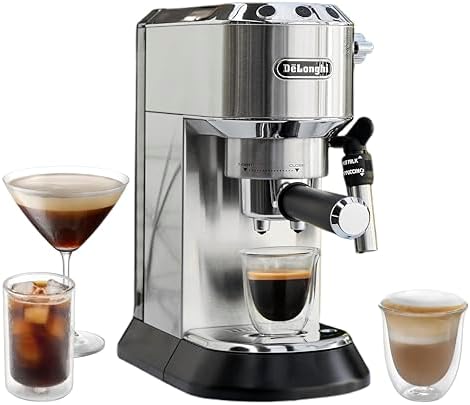
2. De’Longhi Dedica EC685
Best use case: Starter espresso with milk drinks in a very narrow footprint.
Brewing technology: 15-bar pump with Thermoblock heating, per De’Longhi.
Coffee compatibility: Ground coffee or ESE pods. It ships with pressurized filter baskets, which are forgiving for beginners.
Dimensions and tank: De’Longhi’s US listing gives 5.9 × 13 × 12 inches and a 35 oz (about 1 L) removable tank, with room for cups up to about 4.5 inches tall.
Milk frothing: Manual steam wand with an adjustable cappuccino system for hot milk or foam.
Ease of use and cleaning: Three buttons keep it simple, but dialing in grind and tamping takes practice. Cleaning includes the portafilter, steam wand, drip tray, and descaling. For a deeper look, see our De’Longhi Dedica review.
Advantages: Very slim, built-in steaming, flexible coffee choices, cup-warming top.
Disadvantages: You need a separate grinder for the best results. The panarello-style wand is easier than a pro wand but gives less control.
Who should buy it: Budget-minded beginners who want lattes. Who should avoid it: People who want push-button consistency.
- 15-bar professional pressure ensures quality results every time, and adjustable controls allow you to make modifications…
- Whatever your preference – single or double espresso, cappuccino or latte -the machine brews authentic barista-quality b…
- The Premium Adjustable Frother allows you to adjust the foam and steam levels to customize a variety of delicious espres…
3. Breville Bambino
Best use case: The best step toward café-style espresso without a big machine.
Brewing technology: Breville’s Thermojet heating system with a 54 mm portafilter. Retailers list heat-up around 3 seconds. Review the official Breville Bambino specifications for your region’s details.
Coffee compatibility: Ground coffee. There is no built-in grinder.
Dimensions and tank: About 7.7 × 12.6 × 12.2 inches (19.5 × 32 × 31 cm, per Breville Canada) with a 1.4 L tank.
Milk frothing: Manual steam wand. Includes a milk jug in many regional kits. Our take: this wand has more finesse than the Dedica’s, but you have to learn it.
Ease of use and cleaning: One- and two-cup volumetric buttons make shots repeatable. Cleaning involves the portafilter, wand purge and wipe, drip tray, and descaling.
Advantages: Fast start-up, larger tank, strong control for the footprint.
Disadvantages: Highest price of the machines here, and you will want a decent grinder.
Who should buy it: People who want to improve over time. Who should avoid it: People who want one-touch simplicity.

- MICROFOAM MILK TEXTURING: Cappuccino maker and latte machine has an automatic steam wand allowing you to adjust milk tem…
- FASTER HEAT UP TIME: Espresso maker includes innovative ThermoJet heating system that achieves optimum extraction temper…
- BALANCED-TASTING CUP: Manual espresso machine features low pressure pre infusion that gradually increases pressure at th…
4. AeroPress Original
Best use case: The smallest, simplest non-capsule option.
Brewing technology: Manual immersion plus hand pressure. This is important: AeroPress makes espresso-style coffee, not traditional pump-extracted espresso. AeroPress itself uses the “espresso style” wording and describes it as suited for lattes and cappuccinos. See the AeroPress official product information.
Coffee compatibility: Fine-ground coffee with paper filters.
Dimensions and capacity: About 4 inches wide and 9.5 inches tall per a retail listing. AeroPress states it brews up to three espresso-style shots, or one 10 oz serving of regular or cold-brew coffee. There is no water reservoir; you heat water separately.
Milk frothing: None. Pair it with a small handheld frother.
Ease of use and cleaning: Simple, but it is a manual process with a kettle. Cleanup is pushing out the used puck and rinsing.
Advantages: Very low cost, no electricity, tiny storage footprint, flexible recipes.
Disadvantages: No crema from pump pressure, one batch at a time, and a hands-on routine.
Who should buy it: Minimalists and tiny-kitchen owners. Who should avoid it: Anyone who wants espresso shots at the press of a button.

- The Brewer That Started It All – AeroPress Original was the first single cup coffee maker to combine 3 brew methods in o…
- A New Standard in Coffee Flavor – Equal parts French press, pour-over, and espresso, AeroPress patented 3 in 1 technolog…
- The Secret to AeroPress Superior Flavor – Air Pressure and micro-filtration work together to speed up extraction for les…
5. Nespresso CitiZ
Best use case: Same capsule convenience with a bigger tank.
Brewing technology: 19-bar capsule pump, espresso and lungo.
Dimensions and tank: About 5.1 × 14.6 × 10.9 inches, with a 34 oz (1 L) tank, per Breville’s Nespresso specifications. Nespresso lists 25-second heat-up and a capsule container of roughly 9 to 11.
Milk frothing: Machine only. A CitiZ & Milk bundle with a frother exists in some markets, so check availability. Nespresso’s Canadian machine information explains the range.
Ease of use and cleaning: Same as the Pixie, with less frequent refilling.
Advantages: Larger tank, fewer refills, familiar design.
Disadvantages: Bigger than the Essenza Mini and still capsule-only.
Who should buy it: Households of two or more. Who should avoid it: Very tight counters.

- Design: citiz's look continues to Please both Espresso drinkers and design lovers, adding a touch of elegance to coffee …
- COMPLIMENTARY GIFT: Each machine includes a Nespresso Original capsule welcome kit with a range of capsules with unique …
- DESIGN: CitiZ's look continues to please both Nespresso drinkers and design lovers, adding a touch of elegance to Coffee…
Nespresso Essenza Mini vs Alternatives: Which Is Better?
The Essenza Mini is smallest, but that is its main advantage. According to Nespresso’s published specifications, it has a 0.6 L tank, a roughly 6-capsule container, and a 19-bar pump. Nespresso’s Australian machine comparison page lets you compare current models side by side.
| Feature | Essenza Mini | Pixie | CitiZ | Dedica EC685 | Bambino | AeroPress |
|---|---|---|---|---|---|---|
| Footprint width | ~3.3 in. | ~4.4 in. | ~5.1 in. | ~5.9 in. | ~7.7 in. | ~4 in. |
| Water tank | 0.6 L | 0.7 L | 1 L | ~1 L | 1.4 L | None |
| Coffee type | Capsules | Capsules | Capsules | Grounds / ESE pods | Grounds | Grounds |
| Milk | Add-on | Add-on | Add-on | Steam wand | Steam wand | Handheld frother |
| Effort | Lowest | Lowest | Lowest | Medium | Higher | Medium |
Our take: If convenience is what you value, the Pixie or CitiZ is a small step up. If you want more control over flavor and milk, the Dedica or Bambino is the real change. If space and budget dominate, the AeroPress wins.
How to Choose the Best Nespresso Essenza Mini Alternative
Available counter space. Measure width, depth, and height under your cabinets. Steam-wand machines need headroom to fill the tank and cups beneath the wand.
Brewing style. Pick between push-button capsules, semi-manual pump espresso, or a manual press. The machine you will actually use each morning beats the one with the best specs.
Coffee preferences. Want varied beans and roasts? Choose ground-coffee machines. Want consistency with no mess? Capsules.
Capsule and ground coffee costs. Capsules are proprietary and priced per pod. Ground coffee and beans vary widely by quality. Check current prices before assuming either is cheaper.
Milk frothing. If you drink lattes daily, a steam wand is more practical than a separate frother, but it takes practice.
Budget. Include extras: a grinder for the Dedica and Bambino, a kettle for the AeroPress, and a frother for the capsule machines.
Maintenance. Capsule machines need descaling and bin emptying. Pump machines add portafilter and steam-wand cleaning. The AeroPress needs only a rinse.
For more options in this size class, see our best mini coffee makers and space-saving coffee makers.
Are Alternatives to Nespresso Essenza Mini Cheaper?
Look at the upfront cost and the ongoing cost separately.
Initial purchase. The AeroPress is typically the lowest-cost entry. The Pixie and CitiZ are in the same general range as the Essenza Mini. The Dedica and Bambino cost more, and the Bambino is generally the priciest here. Prices change often, so check current listings.
Ongoing coffee. Capsules are sold per pod, usually through Nespresso or compatible-capsule brands. Ground coffee is sold by weight, and cost per cup depends heavily on the beans you choose. Espresso machines and the AeroPress also need fresh grounds, so a grinder can be an added expense.
We are not claiming a specific dollar savings, because it depends on your coffee, your habits, and current prices. The honest answer: non-capsule setups can cost less per cup over time, but only if you use them regularly and factor in the grinder.
If you are weighing similar tradeoffs outside the Nespresso world, our guide to compact coffee maker alternatives covers pod-machine swaps.
Frequently Asked Questions
What is the best alternative to Nespresso Essenza Mini? For the closest match, the Nespresso Pixie. For better espresso and milk drinks, the Breville Bambino or De’Longhi Dedica.
Is Nespresso Pixie better than Essenza Mini? It depends. Per Nespresso’s specifications, the Pixie has a slightly larger tank and capsule bin, but it is also bigger. Brewing is the same style, so “better” mostly means fewer refills.
Which coffee machine is similar to Nespresso Essenza Mini? The Pixie and CitiZ are the most similar: same capsule system, same two cup sizes.
Can I use regular coffee grounds instead of Nespresso capsules? Not in the Essenza Mini, Pixie, or CitiZ, which are built for Nespresso Original capsules. Use a Dedica, Bambino, or AeroPress for ground coffee.
Which compact espresso machine is best for small kitchens? The Dedica is the slimmest of the pump machines here, at about 5.9 inches wide. The Bambino gives more control for a bit more width.
Is AeroPress a good alternative to Nespresso? Yes, if you accept it makes espresso-style coffee, not pump espresso. It is excellent for small spaces and budgets.
Are Nespresso alternatives cheaper in the long run? Possibly, per cup, but it depends on the coffee you buy and whether you need a grinder. Compare current prices.
- Please refer to user guide or user manual or user guide (provided below in PDF) before first use
Final Verdict: Which Alternative Should You Choose?
- Want the easiest swap: Nespresso Pixie.
- Want fewer refills and don’t mind a bigger footprint: Nespresso CitiZ.
- Want affordable espresso with milk drinks: De’Longhi Dedica EC685.
- Want to grow into real espresso: Breville Bambino.
- Want the smallest, cheapest, most flexible option: AeroPress Original.