
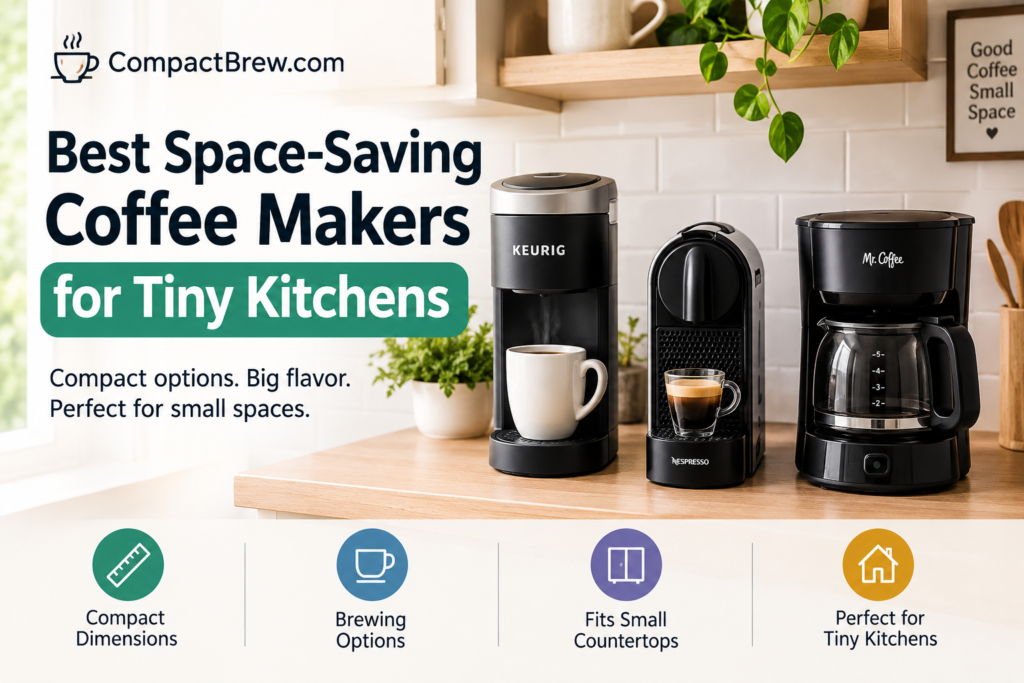
The best space-saving coffee makers are not always the narrowest ones. A 4.5″-wide pod brewer still needs 16.8″ of headroom when its handle is open, and a 3.3″-wide espresso machine runs 13″ deep. This guide compares five compact options on width, depth, opening height, capacity and cleanup, so you can match one to the gap you actually have.
Disclosure: CompactBrew is an Amazon Associate and may earn a commission on qualifying purchases made through links on this page, at no extra cost to you. We put this note up top because the FTC’s disclosure guidance says disclosures should be hard to miss.
How we researched this: desk research, not hands-on testing. Dimensions and features come from manufacturer pages we opened in October 2026, and we say so wherever a spec is missing, conflicting or taken from a retailer. For the standard we aim for, see Google’s guidance on people-first content.
Best space-saving coffee makers at a glance
No single machine wins for every counter. Find the row whose limit you can live with, then read that review.
| Product | Best for | Dimensions (W × D × H) | Brewing style | Capacity | Main space-saving advantage | Main limitation |
|---|---|---|---|---|---|---|
| Keurig K-Mini | One person with a very narrow gap | 4.5″ × 11.3″ × 12.1″ (16.8″ high with handle open) | K-Cup pods | One-cup reservoir, refilled each brew; Keurig’s page gives conflicting brew sizes | 4.5″ body with built-in cord storage | Needs 16.8″ of headroom; refill for every cup |
| Nespresso Essenza Mini | Espresso drinks under low cabinets | 3.3″ × 13″ × 8″ (Breville’s BEC220 page; Nespresso’s own specs unconfirmed) | Nespresso capsules, espresso and lungo | Two programmable cup sizes; tank size unconfirmed | Only 3.3″ wide and 8″ tall | 13″ deep; capsules only |
| Cuisinart DCC-5570NAS | Two people drinking ground coffee | 5.67″ L × 10.14″ W × 10.85″ H as published; orientation unconfirmed | Drip, ground coffee | 5 cups | Removable reservoir fills at the sink | About 10″ along one edge; no timer listed |
| Mr. Coffee 5-Cup Mini Brew Switch | Budget drip for two mugs | Not published on Mr. Coffee’s page | Drip, ground coffee | Up to 25 oz (two 12 oz mugs) | Compact design, per Mr. Coffee | Out of stock when we checked; size unverified |
| AeroPress Go | One cup with no permanent counter space | 4.5″ H × 3.6″ W; packed or in-use size unconfirmed | Manual immersion plus pressure | 8 oz (one cup) | Packs into its own mug and stores in a cabinet | Hand-brewed; needs hot water and a grinder |
Footprint check, our arithmetic from the published numbers: the K-Mini covers about 51 sq in (4.5″ × 11.3″), the Essenza Mini about 43 sq in (3.3″ × 13″) and the Cuisinart about 57 sq in (5.67″ × 10.14″). Footprint hides shape, though. A 13″-deep machine can overrun a shallow counter that a wider, shorter one would clear.
The best space-saving coffee makers for tiny kitchens
Each review below separates what the manufacturer publishes from our own judgment. We have not brewed with any of these machines, so we say nothing about taste, noise or durability.
Keurig K-Mini: best narrow pod brewer for one person

- FITS ANYWHERE: Less than 5 inches wide, perfect for small spaces.
- YOUR PERFECT AMOUNT: Brew any cup size between 6-12oz with Keurig K-Cup pods.
- ONE CUP RESERVOIR: Just add fresh water for each brew.
Verdict: A slim, one-button pod machine that fits gaps a drip maker can’t, if you have the headroom and don’t mind refilling the tank for every cup.
Dimensions: 4.5″ W × 11.3″ D × 12.1″ H, or 16.8″ high with the handle open. It weighs 4.6 lb. Source: Keurig’s K-Mini page.
Brewing and capacity: K-Cup pods, one cup at a time. The reservoir holds one cup, so you add fresh water before each brew. Keurig’s page gives the brew range three different ways (6–12 oz, 6–10 oz and 8–12 oz), so check the user guide for the figure that applies to your unit.
Features, per Keurig: cord storage, auto on and an energy-saver auto off. Keurig’s own comparison chart lists no strength control, no temperature control and no travel-mug fit.
Pros
- At 4.5″ wide, it fits gaps that a drip maker cannot.
- Cord storage keeps the counter tidy.
- One button, no filter or grounds to handle.
Cons
- A refill before every cup, which gets tedious for two people.
- Pods only, with no strength or temperature control.
- Keurig says it does not fit a travel mug.
Buy it if you drink one cup at a time, like K-Cup pods and your tightest limit is counter width. Skip it if two people drink coffee together or you want to control strength.
Space and clearance: The 16.8″ figure matters more than the 4.5″ one. If your upper cabinet sits closer than that, you will slide the machine forward every time you load a pod. At 11.3″ deep, it also leaves under an inch to spare on a 12″-deep counter once the plug is counted.
Nespresso Essenza Mini: best espresso-style option for low cabinets

- Please refer to user guide or user manual or user guide (provided below in PDF) before first use
Verdict: A low-profile capsule machine, the lowest and narrowest in this guide, with the trade-off of the longest depth.
Dimensions: 3.3″ W × 13″ D × 8″ H, per Breville’s US page for the Essenza Mini (BEC220). Breville sells the Nespresso-branded machine. Nespresso’s own Essenza Mini page loaded for us without a specs table, so confirm the dimensions for the exact model and bundle you buy.
Brewing and capacity: Nespresso capsules (Nespresso lists the machine under its Original line). Breville lists two programmable cup sizes, espresso and lungo. We could not confirm the water tank size, so check the spec sheet.
Features: Nespresso describes a 19-bar pressure system, which is a manufacturer claim rather than a test result. Breville’s bundle lists a capsule tasting box and a milk frother as included.
Pros
- Only 8″ tall, so it clears low cabinets that a drip maker would not.
- 3.3″ wide, the narrowest machine here.
- No grinder, portafilter or tamper to store.
Cons
- 13″ deep, which can overrun a shallow counter.
- Capsules only, so you cannot pick your own beans or grind.
- Two small cup sizes, not a full mug of brewed coffee.
Buy it if you want espresso or lungo drinks and your limit is cabinet height or width. Skip it if you want mugs of brewed coffee or prefer to grind your own beans.
Space and clearance: Measure depth first. With 13″ of body, a counter under about 14″ deep leaves almost no room for the cord. The sources we found do not give an opening height, so check the manual for the lever and capsule container.
Cuisinart DCC-5570NAS: best compact drip coffee maker for two

- 5-CUP* COFFEE MAKER: The Cuisinart 5-Cup* Coffee Maker offers a dripless pour spout, Brew Pause, and Keep Warm feature i…
- REMOVABLE WATER RESERVOIR: This drip coffee maker features a removable water reservoir, charcoal water filter, and perma…
- BREW PAUSE & KEEP WARM FEATURES: The Cuisinart coffee maker includes Brew Pause that allows you to pour a cup of coffee …
Verdict: The most practical option here for ground coffee, because it makes a small batch without a pod system, in a body that is wider than the pod brewers but not deep.
Dimensions: 5.67″ L × 10.14″ W × 10.85″ H, as Cuisinart publishes them. The page does not say which edge faces front, and it lists weight as “3.5” with no unit.
Brewing and capacity: Drip, ground coffee, 5 cups. Cuisinart gives no ounce figure, and a drip maker’s “cup” is smaller than a mug, so pour your own mug’s worth of water into the tank to see how many mugs one pot makes.
Features, per Cuisinart: removable water reservoir, stainless carafe with a dripless spout, Brew Pause, a 30-minute keep-warm plate, an easy on/off switch, and a charcoal water filter and permanent-style nylon coffee filter in the box. The warranty is 3 years, limited.
Pros
- Brews two mugs in one cycle instead of two single cups.
- The removable reservoir lets you fill it at the sink, which helps under low cabinets.
- The included permanent filter means no paper filters to store.
- Stainless carafe, so there is no glass to break.
Cons
- About 10″ along one edge, roughly twice the width of the K-Mini.
- Cuisinart’s page lists an on/off switch and no programmable timer.
- Keep-warm is a 30-minute warming plate.
- You supply ground coffee, plus a grinder if you grind fresh.
Buy it if two people share coffee and you prefer ground beans to pods. Skip it if your gap is under about 10″ wide, or you want a timer.
Space and clearance: Confirm which dimension is the width before you count on it; the footprint is about 57 sq in either way. Cuisinart does not publish the height with the lid open, so allow extra headroom above the 10.85″ listed and lift the carafe out toward you rather than straight up.
Mr. Coffee 5-Cup Mini Brew Switch: a budget drip option to watch

- Please refer to user guide or user manual or user guide (provided below in PDF) before first use
- Grab-a-Cup Auto Pause lets you grab a cup before brewing is finished
- Lift & Clean Filter Basket makes for easy cleanup
Verdict: On paper, the simplest low-cost route to two mugs of drip coffee. We can only call it a maybe, because the size is unpublished and the maker’s page showed it out of stock.
Dimensions: Not published on Mr. Coffee’s product page. We are not guessing; check the instruction manual before you buy.
Brewing and capacity: Drip, ground coffee. Mr. Coffee says it makes up to 25 oz, enough for two 12 oz mugs.
Features, per Mr. Coffee: an on/off switch with a power light that reminds you to turn it off, Grab-a-Cup Auto Pause, a carafe with ounce markings, a water window and a lift-and-clean filter basket. A reusable 5-cup filter and a water filtration disk are sold separately. Mr. Coffee’s description says the compact design fits small spaces, which is marketing copy and not a measurement.
Pros
- Brews two mugs per cycle.
- The water window helps you avoid overfilling.
- The basket lifts out for cleaning.
Cons
- No published dimensions, so you cannot check the fit.
- Out of stock on Mr. Coffee’s site when we checked in October 2026.
- The page does not list a timer or automatic shut-off; the power light only reminds you.
Buy it if you are a couple on a budget, your counter is not tight, and you can confirm the size first. Skip it if you need a verified narrow fit or a programmable timer.
Space and clearance: Unknown until you see the manual’s dimensions. Treat it like any 5-cup drip maker: allow room to lift the lid, fill the tank and slide the carafe out.
AeroPress Go: smallest footprint when stored

- Compact Travel Coffee System – Brew smooth, rich coffee anywhere in under 2 minutes. Includes a small, portable version …
- A New Standard in Coffee Flavor – Equal parts French press, pour-over, and espresso, AeroPress patented 3 in 1 technolog…
- The Secret to AeroPress Superior Flavor – Air Pressure and micro-filtration work together to speed up extraction for les…
Verdict: The only pick that lives in a drawer. It trades push-button convenience for almost no permanent counter space.
Dimensions: 4.5″ H × 3.6″ W, per AeroPress. The page does not say whether that is packed or in use. Packed in its mug with accessories and 20 paper filters, it weighs 11.4 oz.
Brewing and capacity: Manual brewing that combines immersion, air pressure and micro-filtration. Capacity is 8 oz, one cup. AeroPress also says it can make up to three espresso-style shots, which is not true espresso.
Features, per AeroPress: the travel mug doubles as the carrying case, with a lid, filter holder, stirrer and scoop included. Parts are dishwasher safe on the top rack, and the warranty is 1 year. AeroPress says to press into a sturdy mug, never thin glass.
Pros
- No permanent counter footprint; it packs into its own mug.
- No outlet needed for the brewer itself.
- A rinse is enough for daily cleanup, per AeroPress.
Cons
- Fully manual, one cup at a time.
- You need hot water from a kettle, and ideally a grinder for the medium-fine grind AeroPress recommends. Both take storage space.
- The page showed both Add to cart and Notify Me, so confirm stock.
Buy it if you live alone in a studio or dorm and enjoy a short brewing routine. Skip it if you want to press a button and walk away.
Space and clearance: It needs counter only while you brew, plus a spot for the kettle and mug. Add the kettle and grinder to your storage math.
How to choose a coffee maker for a tiny kitchen
Start with the numbers on your counter, then match the brewing style to how you actually drink coffee. For a longer walk-through, see our guide to choosing a coffee maker for a small apartment.
- Measure width, depth and height. Width is the open gap between the objects on either side, not the whole counter. Depth runs from the backsplash to the front edge at the narrowest point. Height runs from the counter to the underside of the upper cabinet.
- Compare opening height, not resting height. Lids, pod handles and tank covers all open upward. The K-Mini is 12.1″ tall closed and 16.8″ with the handle open.
- Check how you fill it. A removable tank goes to the sink. A fixed top-fill tank needs headroom or a machine you can slide out. A one-cup tank, like the K-Mini’s, keeps the body slim but adds a refill every brew.
- Find the outlet. Make sure the cord reaches without crossing the sink or stove. Count the plug in your depth measurement.
- Test cup clearance. Measure the gap from spout to drip tray against your tallest mug. Keurig says the K-Mini does not fit a travel mug.
- Match daily volume. One mug a day suits a pod, capsule or manual brewer. Two mugs, or two people, suits a 5-cup drip maker. Three or more mugs back to back may outgrow a compact machine.
- Pick a brewing style from the table below.
- Plan for cleaning and storage. Check each manual for descaling. Decide where wet parts dry and where pods, filters and descaler live.
- Set a budget that includes running costs. We left prices out because they change; check the current price before you buy.
| Style | Space it needs | Effort | Best for |
|---|---|---|---|
| Single-serve pods | Narrowest powered option, plus pod storage | Lowest | One person who values speed |
| Compact drip | Wider and taller, with room for the carafe and lid | Low | Two people, or several mugs |
| Capsule espresso | Narrow and low, but can be deep | Low | Espresso or lungo drinks |
| Manual brewer | Almost none when stored; a kettle and grinder take extra room | Highest | One person who likes the routine |
If your gap is very tight, our roundup of coffee makers for limited counter space compares more options by footprint.
Pods vs. ground coffee in a small kitchen
Pods trade running cost and flexibility for speed. Ground coffee does the opposite.
- Storage. Pods and capsules need a dry cabinet or drawer, and the boxes add up. Ground coffee needs an airtight container and filters. Whole beans also need a grinder.
- Convenience. Pods and capsules are the fastest and cleanest. Ground coffee takes measuring, filter handling and a wash of the basket or carafe.
- Recurring cost. Divide a box’s price by the number of pods, then divide a bag of coffee’s price by the mugs it makes. As an illustration only, a $15 box of 24 pods works out to about $0.63 a cup. Use your own prices.
- Waste. Used pods and capsules are thrown away or recycled depending on local rules. A permanent filter, like the one in the Cuisinart’s box, means no paper filters. Keurig says the K-Mini family has cut virgin plastic by over 1 million pounds since 2020; that is Keurig’s claim and we have not verified it.
- Flexibility. Ground coffee works with any beans. A pod or capsule machine ties you to one system.
For more on the daily trade-offs, see our guide to mini coffee makers for everyday use.
Space-saving tips
- Outline it first. Mark the published width and depth on the counter with painter’s tape and live with it for a day.
- Keep the daily machine within reach. A machine you have to pull out every morning has a bigger real footprint than its label says.
- Store accessories together. Keep pods, filters, scoops and descaler in one basket or drawer near the machine.
- Fill at the sink. A removable tank saves you from pouring water under a low cabinet.
- Let the counter clear. If you only brew one cup, a manual brewer like the AeroPress Go can go back in a drawer between uses.
- Trade one for one. If a new machine goes on the counter, decide which appliance moves off it.
Frequently asked questions
What is the best coffee maker for a very small kitchen?
It depends on your tightest limit. For width, the Keurig K-Mini (4.5″) or the Essenza Mini (3.3″, but 13″ deep). For low cabinets, the 8″-tall Essenza Mini. For ground coffee for two, the Cuisinart DCC-5570NAS. For almost no counter at all, the AeroPress Go.
Which coffee maker takes up the least counter space?
The AeroPress Go takes none when it is stored. Among powered machines, the Essenza Mini has the smallest published footprint here, about 43 sq in, versus about 51 for the K-Mini and 57 for the Cuisinart. That is our arithmetic from published figures, and the Mr. Coffee’s size is unpublished.
Are single-serve coffee makers better for tiny kitchens?
They save width, but not always effort. The K-Mini needs fresh water for every cup, and pods cost more per cup than ground coffee for most people. For two drinkers, a small drip maker is usually less work.
Can a coffee maker fit under kitchen cabinets?
Often, but compare your cabinet gap with the in-use height, not the resting height. The K-Mini needs 16.8″ with its handle open. The Essenza Mini is 8″ tall. The Cuisinart is 10.85″ tall, and its opening height is not published.
Is a compact drip coffee maker better than a pod machine?
Drip is better for several mugs, for sharing and for using any ground coffee. A pod machine is better for one fast cup in the narrowest body.
How do I measure space for a coffee maker?
Measure the open width, the depth from backsplash to counter edge, and the height to the cabinet. Check the outlet. Then compare those numbers with the manufacturer’s dimensions, including opening height where listed.
Are manual coffee makers worth considering when counter space is limited?
Yes, if you only brew one cup and like the routine. A brewer like the AeroPress Go goes back in a drawer, but you will need a kettle and ideally a grinder.
Final verdict: match the machine to your tightest limit
We did not pick one winner, because the right machine depends on whether your limit is width, depth, height or effort.
- Narrow gap, pod drinker: the Keurig K-Mini, if you have 16.8″ of headroom.
- Low cabinets, espresso-style drinks: the Essenza Mini, if your counter is deep enough for 13″.
- Two people, ground coffee: the Cuisinart DCC-5570NAS, if you can spare about 10″ of width.
- Budget drip for two mugs: the Mr. Coffee Mini Brew Switch, only after you confirm its size and stock.
- Almost no counter space: the AeroPress Go, if you accept brewing by hand.
Your next step is to measure width, depth and opening height, then check current prices and availability at the links above. To compare more models, see our best compact coffee makers for small kitchens.
Specs last checked October 17, 2026. Manufacturers change models and listings, so confirm the details before you buy.

Pingback: Nespresso Essenza Mini vs Pixie: Which Compact Espresso Machine Wins? - CompactBrew – Best Compact Coffee Makers & Reviews