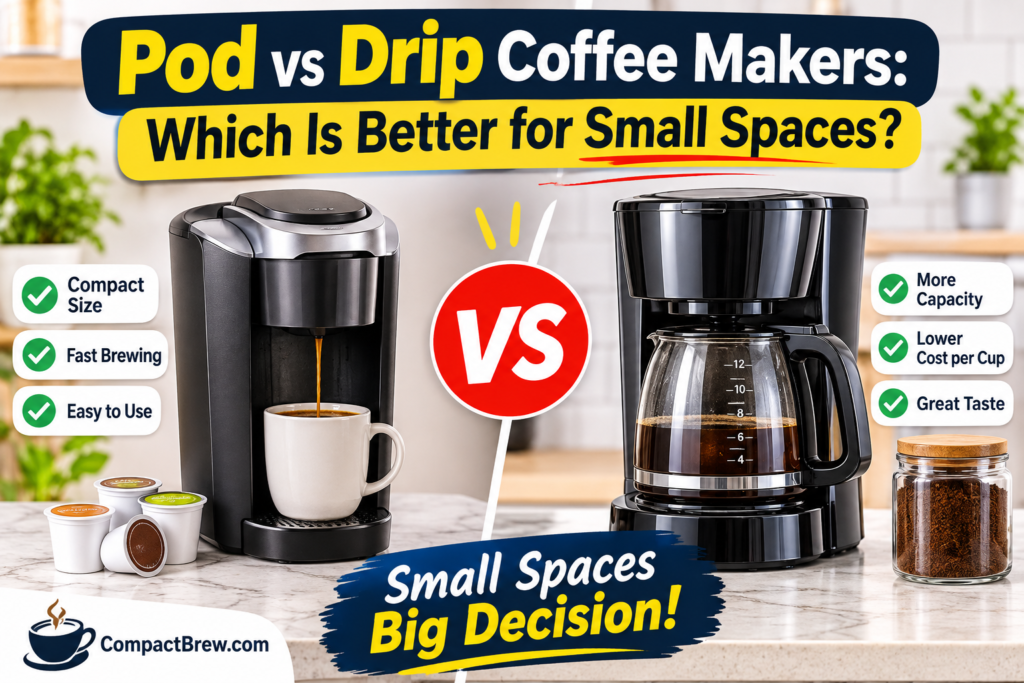
Short counters make coffee makers harder to buy than they should be. A machine that looks tiny in a product photo still needs room to open, to fill, and to sit under a cabinet, plus a spot for pods, grounds, or filters. That is why the pod vs drip coffee makers question matters so much in a small kitchen.
As an Amazon Associate, CompactBrew.com earns from qualifying purchases.
So which is better for small spaces? The answer depends on four things: how much counter space you can spare, how many cups you drink each day, what you want to spend, and where you can store supplies. This guide compares a pod coffee maker vs drip coffee maker on real listed measurements, cabinet clearance, running costs, and household fit. If you want broader picks first, start with our roundup of the best compact coffee makers for small kitchens.
Quick answer: Pod machines tend to be the narrowest and easiest to clean, which suits one-person households. Compact drip machines tend to cost less per cup and can brew enough for two. Neither automatically wins on counter space, and the numbers below show why.
Pod vs Drip Coffee Makers: What’s the Difference?
Both machines heat water and push it through coffee. The difference is what the coffee comes in and how much you make at once.
How a pod coffee maker works
A pod machine brews one cup at a time. You fill a water reservoir, insert a sealed pod (most U.S. models use Keurig-style K-Cups), lower the handle, and press a button. Consumer Reports describes single-serve machines as heating water and pushing it through a small packet, pod, or capsule, and notes that some accept an adapter so you can use loose grounds instead.
The smallest pod machines go further. Keurig’s K-Mini has a one-cup reservoir, so you add fresh water for every brew.
How a drip coffee maker works
A drip machine heats a tank of water and drips it over ground coffee in a filter basket, then collects the result in a carafe. Compact models are usually sold as 4- or 5-cup machines. Keep in mind that drip makers define a “cup” as roughly 5 to 6 ounces, not a full 8-ounce cup, according to Consumer Reports’ coffee maker buying guide. A 5-cup machine, for example, makes about 25 ounces, or roughly two large mugs.
Single serve vs drip coffee maker: the practical split
When people compare a single serve vs drip coffee maker, they are really choosing between convenience per cup and flexibility per pot. Pods give you speed and almost no measuring. Drip gives you control over the coffee you buy and the amount you brew. For readers who want a closer look at the pod side, our guide to the best compact single serve coffee makers goes deeper.

- STRONG BREW: Increases the strength and bold taste of your coffee’s flavor.
- 3 CUP SIZES: Brew an 8, 10, or 12 oz. cup at the push of a button.
- MULTIPLE CUP WATER RESERVOIR: 42oz. removable reservoir lets you brew up to 4 cups before refilling. 8 oz. cup size

- AUTO SHUTOFF: Built-in 2-hour automatic shutoff ensures safety and energy savings
- SLEEK DESIGN: Modern, polished appearance complements any contemporary kitchen with a compact 5-cup capacity
- PAUSE & POUR: Auto-pause lets you grab a cup mid-brew without mess
Pod vs Drip Coffee Makers: Quick Comparison
The table below compares the two categories in general terms. Example dimensions come from the manufacturer and retailer listings covered in the counter-space section. Always check the exact model you plan to buy, because sizes vary between versions.
| Factor | Compact pod coffee maker | Compact drip coffee maker |
|---|---|---|
| Countertop footprint | Narrow and deep. Keurig lists the K-Mini at about 4.5 in. wide by 11.3 in. deep. | Wider and shallower. Listings for the 5-cup models we checked show about 6 to 8 in. in each direction. |
| Width, depth, height | K-Mini: 4.5 W x 11.3 D x 12.1 H in. (Keurig listing) | Capresso 5-Cup: 6.25 W x 8 L x 10 H in. (Capresso) |
| Cabinet clearance | Handle swings up. The K-Mini is listed at 16.8 in. with the handle open; the K-Express at 17.2 in. | Usually shorter, but you often need to reach the top to fill the tank and basket. |
| Brewing capacity | One cup per brew; the K-Mini brews 6 to 12 oz. | About 25 oz (5 small cups) in 5-cup models. |
| Brewing speed | Fast for one cup. Slower overall if several people need coffee. | A full pot takes several minutes, but one batch covers two mugs. |
| Coffee taste | Consistent from cup to cup. Consumer Reports says pod coffee is unlikely to match a top-performing drip brewer. | Depends on the machine and the coffee you buy. Fresh ground coffee gives you more room to improve results. |
| Convenience | Highest: no measuring, no filter. | More steps: measure, fill, filter, brew. |
| Cleaning | Discard the pod and wipe the drip tray; descale periodically. | Wash the carafe, basket, and filter; descale periodically. |
| Initial cost | Varies widely by model and season. Check current prices. | Varies widely by model and season. Check current prices. |
| Cost per cup | Usually higher, because Consumer Reports notes pods cost more than most ground coffee. | Usually lower, because ground coffee is cheaper per cup. |
| Storage requirements | Pod boxes or a pod holder. | A bag or canister of coffee plus filters. |
| Environmental impact | Used pods are single-use plastic. Recycling depends on your location. | Grounds and paper filters can be composted; reusable filters create less waste. |
Pod Coffee Makers for Small Spaces
Pod machines are popular in small kitchens for good reasons, and a few real drawbacks.
Pod coffee maker pros and cons
Pros
- Narrow profile. A compact pod coffee maker like the K-Mini is listed at under 5 inches wide, which fits beside a kettle or microwave.
- Fast, low-effort mornings. Fill, insert, press. Consumer Reports says pod machines generally need less cleanup than drip makers.
- Good for one person. You brew only what you drink, so nothing sits on a hotplate.
- Variety. Consumer Reports notes that K-Cups come in a much wider range of blends and brands than Nespresso capsules.
Cons
- Higher running costs. Pods cost more than most ground coffee, according to Consumer Reports.
- Waste. Spent plastic pods can end up in landfills, even though major makers say their pods are recyclable.
- Limited batch size. The smallest models brew one mug at a time, so serving two people means two cycles.
- Taste. Consumer Reports says pod coffee generally isn’t as fresh-tasting as what a top-performing drip brewer makes.
- STRONG BREW: Increases the strength and bold taste of your coffee’s flavor.
- 3 CUP SIZES: Brew an 8, 10, or 12 oz. cup at the push of a button.
- MULTIPLE CUP WATER RESERVOIR: 42oz. removable reservoir lets you brew up to 4 cups before refilling. 8 oz. cup size
- AUTO SHUTOFF: Built-in 2-hour automatic shutoff ensures safety and energy savings
- SLEEK DESIGN: Modern, polished appearance complements any contemporary kitchen with a compact 5-cup capacity
- PAUSE & POUR: Auto-pause lets you grab a cup mid-brew without mess
Pod storage and running costs
Pods need a home. A box of 20 to 24 pods is small, but it adds up if you stock several flavors. If you want to cut down on boxes, some Keurig-style machines work with a reusable filter you fill with your own grounds. Keurig Care has said the K-Mini works with the My K-Cup universal reusable filter, and retailer listings say the same of the K-Express. That gives you a middle path between pod convenience and ground coffee prices.
For a repeatable way to compare costs, use the formulas in the running-cost section below.
Pod waste and recycling
Keurig states that its K-Cup pods have been made recyclable since 2020 and are made from #5 polypropylene plastic. Its K-Cup recycling page also says the pods are not recycled in many communities and tells shoppers to check locally. The steps it describes are to peel the lid, empty the grounds, and recycle the cup if your program accepts it. It also describes a mail-in option. In other words, a recyclable pod is not the same as a recycled pod. Check your city’s accepted-materials list before you count on it.
Where pod machines fall short
The limits show up in specific situations. If you drink three or four mugs a day, if two people brew back to back, or if you like to fill a thermos, a one-cup reservoir and a per-pod price become frustrating. The machine may be small, but the daily routine isn’t.
Drip Coffee Makers for Small Spaces
Compact drip machines trade a little width for more flexibility.
How compact drip machines work
A 4- or 5-cup drip machine works like its full-size cousin, only smaller. Water from the tank drips over grounds in a basket, and coffee collects in a carafe on a warming plate. Many models include a pause-and-serve feature that lets you pour a cup before the cycle finishes. For example, Mr. Coffee’s 5-cup Mini Brew lists a Grab-a-Cup pause, and the KRUPS Simply Brew 5-cup lists Pause & Serve.
Ground coffee is the main reason people choose them. You pick the beans or grind, you choose how strong to make it, and you pay a lower price per cup.
Drip coffee maker pros and cons
Pros
- Lower ongoing costs. Consumer Reports notes that pods cost more than most ground coffee or whole beans.
- Brews for two. A 25-ounce batch covers about two 12-ounce mugs, which is how Mr. Coffee describes its 5-cup model.
- Control. You can choose the grind, the brand, and how much coffee to use.
- Reusable filters. Some models, such as the Capresso 5-Cup Mini Drip, include a permanent GoldTone filter, which removes the need for paper filters.
- Fresher potential. Consumer Reports says its best drip machines keep water in the 195 to 205 degree F range for several minutes, which helps determine how coffee tastes.
Cons
- Hotplate effects. Consumer Reports notes that constant heat on a hotplate may affect flavor, and many plates shut off after a set time.
- More cleanup. You wash a carafe, a basket, and possibly paper or reusable filters.
- Wider footprint. Compact drip models tend to be wider than the slimmest pod machines.
- Batch brewing. If you only want one small cup, a full carafe may waste coffee.
Filters, carafes, and cleaning
Check which filter your model takes before you buy. The Capresso and KRUPS machines listed on their manufacturers’ sites include permanent filters, while Mr. Coffee’s Mini Brew works with paper filters or a 5-cup reusable filter sold separately. Paper filters are cheap, but they are another item to store.
The glass carafe is the other storage and cleaning decision. KRUPS states that its glass pot and filter receptacle can go on the top rack of a dishwasher, which helps in a small kitchen where sink space is tight.
For more on picking the right compact machine for your space, see our guide to the best small coffee makers for limited counter space.
- STRONG BREW: Increases the strength and bold taste of your coffee’s flavor.
- 3 CUP SIZES: Brew an 8, 10, or 12 oz. cup at the push of a button.
- MULTIPLE CUP WATER RESERVOIR: 42oz. removable reservoir lets you brew up to 4 cups before refilling. 8 oz. cup size
- AUTO SHUTOFF: Built-in 2-hour automatic shutoff ensures safety and energy savings
- SLEEK DESIGN: Modern, polished appearance complements any contemporary kitchen with a compact 5-cup capacity
- PAUSE & POUR: Auto-pause lets you grab a cup mid-brew without mess
Where compact drip machines fall short in narrow kitchens
Drip machines generally take more room side to side. A narrow counter next to a stove may fit a 4.5-inch pod machine but not an 8-inch drip machine. They also usually need space for a bag of coffee and filters nearby, and you will want clearance to reach the water tank and basket.
Pod vs Drip Coffee Makers: Which Takes Up Less Counter Space?
This is the question most small-kitchen shoppers care about most, and advertised size only tells part of the story. What matters is how much room the machine needs when you are actually using it. Our guide to space-saving coffee makers for tiny kitchens covers more models.
Listed dimensions for popular compact models
The table shows dimensions as listed by manufacturers or retailers. We have not measured these machines ourselves. Where sources disagreed, we say so.
| Model | Type | Listed size (W x D x H) | Open or in use | Where the number comes from |
|---|---|---|---|---|
| Keurig K-Mini | Pod | 4.5 x 11.3 x 12.1 in. | 16.8 in. high with handle open | Keurig product listing; some other listings show different sizes for other K-Mini versions |
| Keurig K-Express | Pod | About 5 in. wide; listings vary (4.56 to 5.1 in. wide, 12.6 to 12.9 in. deep and tall) | 17.2 in. high with handle up | Retailer and third-party listings; they disagree on exact figures |
| Capresso 5-Cup Mini Drip (426.05) | Drip | 6.25 x 8 x 10 in. (listed as W x L x H) | Not listed | Capresso product page |
| KRUPS Simply Brew 5-Cup | Drip | 8.07 x 5.71 x 10.08 in. | Not listed | Retailer listings; the KRUPS U.S. page did not show dimensions |
| Mr. Coffee 5-Cup Mini Brew | Drip | Varies by version (switch and programmable models differ) | Not listed | Listings conflict, so measure the exact model |
What the numbers show
The first surprise is footprint. Multiplying width by depth from the listings gives about 51 square inches for the Keurig K-Mini (4.5 x 11.3), about 50 for the Capresso (6.25 x 8), and about 46 for the KRUPS (8.07 x 5.71). That is our own arithmetic from the listed figures, and it only holds if those listings are right. The takeaway is still useful: a slim pod machine and a compact drip machine can use nearly the same amount of counter area. They just use it differently. The pod machine is narrow and deep, and the drip machine is wide and shallow.
That shape difference matters. A narrow, deep machine fits a gap beside the fridge or a corner better. A wide, shallow machine can slide against a backsplash with a few inches to spare in front.
Height and cabinet clearance
Height is where pod machines can surprise you. A K-Mini is listed at 12.1 inches closed but 16.8 inches with the handle open, and the K-Express is listed at 17.2 inches with the handle up. Many kitchens have somewhere around 18 inches between the counter and the wall cabinets, but that varies, so measure yours. If your gap is tight, a machine that needs about 17 inches to open leaves very little room to spare.
Consumer Reports says every machine in its tests fits under standard upper cabinets. It also warns that, depending on the height and how you fill it, you may need to pull some machines out from under the cabinet to set up the filter or fill the reservoir.
Clearance you need to use the machine
Before you decide, check these points:
- Pod handle. Does the handle open fully without hitting the cabinet?
- Drip lid or basket. Can you open the lid and swing the filter basket without sliding the machine out?
- Water reservoir. Is it removable, and can you reach it? A removable tank can be filled at the sink.
- Carafe. Can you pull the carafe straight out, or does it need space overhead?
- Supplies. Where will pods, grounds, and filters live? A pod box or coffee canister takes room too.
An easy test is to cut a piece of cardboard to the listed width and depth, tape a string at the listed open height, and hold it where the machine would sit. If you are still deciding what fits your kitchen, our guide on how to choose a coffee maker for a small apartment walks through the same measuring steps.
- STRONG BREW: Increases the strength and bold taste of your coffee’s flavor.
- 3 CUP SIZES: Brew an 8, 10, or 12 oz. cup at the push of a button.
- MULTIPLE CUP WATER RESERVOIR: 42oz. removable reservoir lets you brew up to 4 cups before refilling. 8 oz. cup size
- AUTO SHUTOFF: Built-in 2-hour automatic shutoff ensures safety and energy savings
- SLEEK DESIGN: Modern, polished appearance complements any contemporary kitchen with a compact 5-cup capacity
- PAUSE & POUR: Auto-pause lets you grab a cup mid-brew without mess
Which Coffee Maker Is Cheaper in the Long Run?
Up-front prices change often, and pod prices vary by brand, box size, and promotions. We are not publishing a cost-per-cup figure here, because a number from one week would be out of date the next. Instead, use this method with current prices from the store you shop at.
The cost per cup formula
- Pods: price of the box divided by the number of pods in it.
- Ground coffee: price of the bag divided by the number of brews it makes. To work out brews, divide the bag weight by the amount of coffee you use per brew.
- Paper filters: price of the pack divided by the number of filters, added to each brew. Reusable filters cost nothing per brew once bought.
- Machine cost: divide the purchase price by the number of cups you expect to brew over its life, then add that to your per-cup figure.
Assumptions to write down for your own comparison: how many cups you drink per day, the exact coffee you plan to buy, and whether you will use paper or reusable filters. Change any of these and the result changes.
What to expect
Consumer Reports says pod machines tend to be more expensive to run than other types because pods cost more than most ground coffee or whole beans. That matches the general pattern, but your own numbers will decide. A premium bag of ground coffee can cost more per cup than a basic pod, and a cheap pod box can undercut a premium bag.
Machines themselves are not all expensive. Consumer Reports says you can brew a great cup with a coffee maker that costs less than $100, and a few good ones cost under $50. For ideas, see our list of budget coffee makers for small kitchens.
Maintenance costs
Both types need descaling. KRUPS’s own FAQ ties descaling to water hardness and use, suggesting roughly every 20 to 40 cycles or about once a month. Pod machines need descaling too, and Keurig sells a care kit for that. Budget for a descaling solution or white vinegar either way.
Which Makes Better-Tasting Coffee?
Taste is personal, and a machine is only part of the story. It is not accurate to say every drip machine beats every pod machine, so here is what we can say.
- Freshness. Consumer Reports’ experts say pod coffee generally isn’t as fresh or as high-quality as what a top-performing drip brewer makes. Ground coffee that you store well and use quickly gives you more control. KRUPS recommends keeping ground coffee in an airtight container.
- Consistency. Pods are very repeatable. Consumer Reports tests pod machines for cup-to-cup temperature and size consistency, which is where single-serve machines are designed to do well.
- Strength. Many pod machines offer a strong button or smaller cup sizes. With drip, you control the amount of coffee you use.
- Flexibility. Drip lets you change coffee brands, grinds, and ratios. Pods let you change flavors without opening a bag.
- Standards. The Specialty Coffee Association publishes industry coffee standards, including a standard for home coffee brewers’ specifications and test methods. It is available to members, so we are not quoting it. It does show that brewer performance is something that can be measured rather than only argued about.
If you like milk and sugar, the difference may matter less. If you drink black coffee, it may matter more.
- STRONG BREW: Increases the strength and bold taste of your coffee’s flavor.
- 3 CUP SIZES: Brew an 8, 10, or 12 oz. cup at the push of a button.
- MULTIPLE CUP WATER RESERVOIR: 42oz. removable reservoir lets you brew up to 4 cups before refilling. 8 oz. cup size
- AUTO SHUTOFF: Built-in 2-hour automatic shutoff ensures safety and energy savings
- SLEEK DESIGN: Modern, polished appearance complements any contemporary kitchen with a compact 5-cup capacity
- PAUSE & POUR: Auto-pause lets you grab a cup mid-brew without mess
Which Is Easier to Clean and Maintain?
| Task | Pod machine | Compact drip machine |
|---|---|---|
| Daily | Discard the used pod; empty or wipe the drip tray | Rinse the carafe, basket, and filter |
| Used coffee grounds | Mostly sealed in the pod unless you use a reusable filter | Dump grounds and paper filter, or rinse a permanent filter |
| Removable parts | Reservoir, drip tray, pod holder; check which parts are dishwasher safe | Carafe, lid, basket; some are dishwasher safe |
| Descaling | Periodic, using the maker’s instructions | Periodic, based on water hardness |
| Mess risk | Low | Moderate (loose grounds, wet filters) |
Pod machines win on daily effort. Consumer Reports says single-serve machines need less cleanup than drip. Dishwasher safety varies by model, though. Keurig’s care guidance for its K-Mini Go warns that its parts are not dishwasher safe, so check your model’s manual.
For drip machines, you can compost the grounds. The EPA’s guide to composting at home lists coffee grounds and paper filters among the items that can go into a backyard compost pile or a worm bin. If you have no outdoor space, the EPA suggests looking for a community or municipal program.
Which Coffee Maker Is Better for Different Households?
Use these as starting points, not rules.
- One-person households. A pod machine is usually the easier fit if you drink one or two cups a day. A 1- to 2-mug drip maker is another option if you prefer ground coffee. Consumer Reports suggests either for one or two cups a day.
- Couples. A 5-cup drip machine makes about two large mugs in one go, which is often easier than two pod cycles.
- Small families. A compact machine may not keep up. Consumer Reports notes that larger drip models brew 10 to 14 cups, so consider a bigger drip machine if you need more than a couple of mugs.
- Studio apartments. Narrow depth and a short open height matter most. Measure the spot first. If you are shopping for a coffee maker for small apartments, add storage for supplies to your measurements.
- Dorm rooms. Pods are simple and need no filters, but check your building’s rules about appliances.
- Home offices. A pod machine fits a desk-side shelf and brews a cup on demand. A thermal or self-serve model suits people who sip over several hours, per Consumer Reports.
- People who drink multiple cups daily. Drip usually costs less per cup and suits this best. A pod machine can work if you use a reusable filter with your own grounds.
Best Compact Pod and Drip Coffee Makers to Consider
These are examples worth checking, not tested picks. CompactBrew has not personally tested any of them. Specifications come from manufacturer or retailer listings and can change, so confirm them on the product page before you buy. We have not listed retailer prices because they change often.
Compact pod options
Keurig K-Mini. Keurig’s listing gives a width under 5 inches, a one-cup reservoir, 6 to 12 oz brew sizes, and cord storage. It is listed at 16.8 inches high with the handle open. Different K-Mini versions have different listed sizes, so check the model number.

- FITS ANYWHERE: Less than 5 inches wide, perfect for small spaces.
- YOUR PERFECT AMOUNT: Brew any cup size between 6-12oz with Keurig K-Cup pods.
- ONE CUP RESERVOIR: Just add fresh water for each brew.
Keurig K-Express. Listings describe three brew sizes (8, 10, and 12 oz), a Strong button, and a larger removable reservoir (listed as 42 oz). It is a bit larger than the K-Mini and is listed at 17.2 inches with the handle up. Listed dimensions vary by source, so confirm them.
- STRONG BREW: Increases the strength and bold taste of your coffee’s flavor.
- 3 CUP SIZES: Brew an 8, 10, or 12 oz. cup at the push of a button.
- MULTIPLE CUP WATER RESERVOIR: 42oz. removable reservoir lets you brew up to 4 cups before refilling. 8 oz. cup size
Compact drip options
Capresso 5-Cup Mini Drip (426.05). Capresso lists a 25-ounce glass carafe, a 24-hour programmable timer, a permanent GoldTone filter, a two-hour warming plate and shut-off, and dimensions of 8 x 6.25 x 10 inches. Capresso’s page showed a list price of $49.99 when we checked it on November 15, 2026.

- Please refer to user guide or user manual or user guide (provided below in PDF) before first use
KRUPS Simply Brew 5-Cup. KRUPS lists a 5-cup glass pot, a permanent filter, a pause-and-serve system, an automatic keep-warm function, and 650 watts. Retailer listings give 5.71 x 8.07 x 10.08 inches, but the manufacturer page did not show dimensions. The KRUPS site also showed a recommended price of $34.99 on the date we checked, which may differ from retailer prices.

- Compact Design: The coffee machine is great for small kitchens or offices this coffee maker brews just the right amount …
- Pause & Brew Function: Enjoy the flexibility to pour a cup mid-brew without a mess with the small drip coffee maker. Thi…
- Keep Warm Feature: Maintain your coffee at the optimal temperature for up to 30 minutes after brewing with this compact …
Mr. Coffee 5-Cup Mini Brew. Mr. Coffee describes this model as making up to 25 ounces, which is about two 12-ounce cups, with a pause feature, a water window, and a lift-and-clean filter basket. Several versions exist (switch and programmable) with different listed sizes, and the manufacturer page was marked out of stock when we checked. Confirm the exact model.

- Please refer to user guide or user manual or user guide (provided below in PDF) before first use
- Grab-a-Cup Auto Pause lets you grab a cup before brewing is finished
- Lift & Clean Filter Basket makes for easy cleanup
If none of these fit, you may find a better match in our best compact single serve coffee makers and best compact coffee makers for small kitchens guides.
For combination machines that brew both pods and a pot, Consumer Reports’ single-serve coffee maker roundup names a Hamilton Beach model as its top-rated combination brewer. Combination machines usually take more counter space, so check their size first.
Pod vs Drip Coffee Makers: Which Should You Choose?
The best answer in the pod vs drip coffee makers debate depends on your habits more than on the machines.
Choose a pod machine if you value:
- A narrow countertop footprint
- Single servings
- Fast preparation
- Minimal daily cleanup
Choose a compact drip machine if you value:
- Lower ongoing coffee costs
- Ground coffee
- Brewing more than one serving
- More control over strength
The smallest machine is not automatically the best choice. A slim pod machine that hits your cabinet when the handle opens, or a one-cup reservoir that you refill all morning, can be more of a hassle than a slightly larger machine that fits your routine. Measure your counter, your cabinet gap, and your storage space, then match them to how you actually drink coffee.
- STRONG BREW: Increases the strength and bold taste of your coffee’s flavor.
- 3 CUP SIZES: Brew an 8, 10, or 12 oz. cup at the push of a button.
- MULTIPLE CUP WATER RESERVOIR: 42oz. removable reservoir lets you brew up to 4 cups before refilling. 8 oz. cup size
- AUTO SHUTOFF: Built-in 2-hour automatic shutoff ensures safety and energy savings
- SLEEK DESIGN: Modern, polished appearance complements any contemporary kitchen with a compact 5-cup capacity
- PAUSE & POUR: Auto-pause lets you grab a cup mid-brew without mess
Frequently Asked Questions
1. Are pod coffee makers better for small kitchens?
Often, because the slimmest models are very narrow and need little cleanup. But some are tall when open, and a compact drip machine can use about the same counter area. Compare listed dimensions and your cabinet gap.
2. Are drip coffee makers cheaper than pod machines?
Usually to run, because Consumer Reports notes pods cost more than most ground coffee. Machine prices vary on both sides, so use the cost formulas above with current prices.
3. Which coffee maker takes up less counter space?
It depends on the model. The listed footprints we checked were similar, at roughly 46 to 51 square inches. Pod machines are narrower and drip machines are shallower. Pod machines can also need more height to open.
4. Do pod coffee makers use more electricity?
We could not find reliable head-to-head data, so we will not claim a winner. Check each machine’s wattage and auto-off. For example, a retailer listing for the K-Express describes shut-off 5 minutes after the last brew, while Capresso lists a two-hour warming plate and shut-off for its drip machine.
5. Can drip coffee makers make just one cup?
Some can. Consumer Reports describes 1- to 2-mug drip models designed for small amounts of coffee. With a standard 5-cup machine, check the manual for the minimum amount it is meant to brew.
6. Are coffee pods more expensive than ground coffee?
Generally yes, according to Consumer Reports. Check current prices to see how it works out for the brands you like.
7. Which coffee maker is easier to clean?
Pod machines, for daily cleanup, according to Consumer Reports. Drip machines have more parts to wash, though the carafe and filter parts on some models are dishwasher safe.
8. Is a compact drip coffee maker worth buying?
It is a good fit if you drink one or two mugs a day, prefer ground coffee, and want lower running costs. It is less ideal if you want one quick cup with no cleanup or share a very narrow counter.