
Disclosure: CompactBrew may earn a commission if you buy through links on this page, at no extra cost to you. As an Amazon Associate I earn from qualifying purchases.
Specifications and prices were checked on October 26, 2026. Prices and availability can change. This is a research-based guide, not a hands-on test; we do not report our own taste, temperature, noise, or durability measurements.
The best compact coffee makers without pods let you brew ground coffee without surrendering the whole counter—or buying proprietary capsules. Our top choices are the Zojirushi ZUTTO EC-DAC50 for an especially shallow drip machine with a removable tank, the KRUPS Simply Brew 5-Cup for a low purchase price and included permanent filter, and the AeroPress Go if you would rather store the brewer in a drawer than leave it out.
The right choice depends on your routine:
- Best compact drip for awkward spaces: Zojirushi ZUTTO EC-DAC50
- Best budget drip with a reusable filter: KRUPS Simply Brew 5-Cup KM202850
- Best pod-free electric single-serve: Hamilton Beach The Scoop 49981
- Best manual brewer with almost no permanent footprint: AeroPress Go
- Best small-batch option for one or two people: Cuisinart DCC-5570NAS
- Best premium option for small batches or a carafe: OXO Brew 8-Cup 8718800
A crucial point: single-serve does not automatically mean pods. The Hamilton Beach below uses loose ground coffee and a mesh scoop filter. Manual brewers such as the AeroPress Go also make one serving without pods, although you must heat the water separately.
If you are open to capsule or espresso formats too, see our broader guide to the best compact coffee makers for small kitchens. This article focuses specifically on pod-free brewing.
The Best Compact Coffee Makers Without Pods
Zojirushi ZUTTO EC-DAC50 — Best Compact Drip for Awkward Spaces
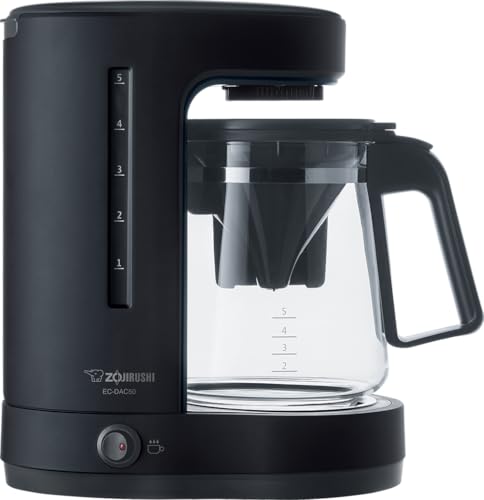
- Convenient 5-cup size with removable water tanks makes filling easy and is fully washable.
- Automatic keep warm.
- Compct Design, ideal for small spaces.
Verdict: A thoughtfully arranged five-cup drip maker whose shallow body and removable water tank are more useful in a tight kitchen than a long feature list. It is our strongest fit-focused choice, not a claim that it universally makes the best coffee.
Best for: One or two coffee drinkers who want automatic drip and need to fill the tank at the sink.
Verified specifications
- Type: Automatic drip; ground coffee; no pods
- Capacity: Five coffee-maker cups; maximum 24 ounces (680 mL)
- Published dimensions: Approximately 8.9 inches W × 5.9 inches D × 10.6 inches H
- Approximate countertop footprint: 52.5 square inches, calculated from published width and depth
- Power and weight: 120 V, 650 W; approximately 3.5 pounds
- Filter: No. 2 cone paper filter
- Water access: Removable, washable water tank
- Other features: Automatic keep-warm; charcoal water filter; single-switch operation
- Warranty: One-year limited warranty
- Price at research time: $89.95 at Williams Sonoma; check the current seller and price
Key features and counter-space guidance
The ZUTTO is wider than it is deep, which can work well along a backsplash where front-to-back space is scarce. Its standout feature is the removable tank: you can carry it to the sink rather than angle a carafe into a fixed top-fill opening beneath a cabinet.
That does not eliminate every clearance issue. You still need access to the brew basket and carafe, and Zojirushi does not publish a working/open-lid height in the specifications we reviewed. Measure the actual unit if overhead clearance is exceptionally tight, or plan to slide it forward for loading.
Pros
- Removable tank simplifies filling in confined spaces.
- Very shallow published depth for an automatic drip machine.
- Small-batch capacity avoids heating a full-size carafe for one or two people.
- Charcoal water filtration is included; Zojirushi says the filter can last up to two years under normal use.
Cons
- Requires No. 2 cone paper filters; a permanent stainless-mesh filter is not accommodated, according to the manufacturer’s retailer Q&A.
- No programmable timer is listed.
- Glass carafe and keep-warm plate are less appealing for slow drinkers than a thermal carafe.
- Costs substantially more than the KRUPS budget pick.
Brewing and coffee guidance
The manual recommends a medium grind and warns that overly fine coffee may clog the filter or cause overflow. Those model-specific instructions matter more than a generic grind chart. A search-visible Wirecutter update dated October 17, 2025 described the ZUTTO as the smallest model in that test and said it produced consistently hot coffee; we did not independently reproduce those results.
Cleaning and maintenance
Remove and wash the water tank as directed, discard the paper filter and grounds after brewing, and clean the carafe and removable parts regularly. Follow Zojirushi’s manual for descaling rather than applying a universal calendar interval. Replace the charcoal filter according to the manufacturer’s usage guidance.
Who should buy it: Someone whose kitchen layout makes a removable tank and shallow body worth paying for.
Who should skip it: Buyers who want the lowest price, an included reusable coffee filter, a programmable timer, or a thermal carafe.
Check the Zojirushi ZUTTO EC-DAC50
KRUPS Simply Brew 5-Cup KM202850 — Best Budget Drip With a Reusable Filter

- Compact Design: The coffee machine is great for small kitchens or offices this coffee maker brews just the right amount …
- Pause & Brew Function: Enjoy the flexibility to pour a cup mid-brew without a mess with the small drip coffee maker. Thi…
- Keep Warm Feature: Maintain your coffee at the optimal temperature for up to 30 minutes after brewing with this compact …
Verdict: The most affordable compact coffee maker for ground coffee in this guide, with a permanent filter included and no complicated controls. It is a practical value pick as long as a glass carafe and basic feature set match your routine.
Best for: Budget-conscious solo drinkers, couples, offices, and first apartments.
Verified specifications
- Type: Automatic drip; ground coffee; no pods
- Capacity: Five cups; official replacement carafe capacity is 0.75 L
- Retail-listed dimensions: 5.7 inches W × 8.1 inches D × 10.1 inches H; official reconfirmation is pending
- Approximate countertop footprint: 46.2 square inches, calculated from published width and depth
- Power: 120 V, 650 W
- Filter: Permanent filter included; KRUPS says paper or permanent nylon/metal filters may be used
- Carafe: Glass
- Other features: Pause & Serve; Keep Warm; measuring spoon
- Warranty: Not independently confirmed for this exact model during final research
- Manufacturer recommended price: $34.99
Key features and counter-space guidance
This is the narrowest electric drip footprint in our shortlist. The simple control layout avoids paying for programming you may never use. Included accessories—the carafe, permanent filter, and spoon—are listed as dishwasher-safe by KRUPS.
The published height is only the closed/resting height. We did not find a verified open-lid or working-height measurement, so do not assume it will load comfortably beneath your cabinet. Allow access to the top and room to remove the carafe.
Pros
- Lowest manufacturer recommended price among the electric picks here.
- Permanent filter included, reducing the need to buy paper filters.
- Narrow footprint and straightforward operation.
- Pause & Serve lets you pour during brewing when used as instructed.
Cons
- No programmable timer is listed.
- A glass carafe on a warming plate is best suited to coffee that will be poured relatively promptly.
- Five small coffee-maker cups are not five full mugs.
- Warranty duration was not confirmed; check the warranty supplied by the seller before purchase.
Brewing and filter guidance
KRUPS permits either paper or a permanent nylon/metal filter, but its FAQ warns against placing a paper filter inside a permanent filter. If sediment bothers you, a correctly sized paper filter may be preferable; if easy disposal and fewer consumables matter more, use the included filter.
Cleaning and maintenance
Empty and rinse the permanent filter after use and wash the included accessories as directed. KRUPS’s support material gives more than one descaling schedule and ties frequency to water hardness and use. The safest advice is to follow the current model instructions and descale more often with hard water rather than treat one interval as universal.
Who should buy it: Anyone seeking a small coffee maker with reusable filter convenience at a low upfront cost.
Who should skip it: Buyers who need a timer, a thermal carafe, verified long warranty coverage, or a removable reservoir.
Check the KRUPS Simply Brew 5-Cup
Hamilton Beach The Scoop 49981 — Best Pod-Free Electric Single-Serve

- Note: 1)Too coarse a grind, too little coffee, or insufficiently tamping the grounds before brewing can all lead to inad…
Verdict: A genuinely compact single-serve coffee maker without pods, built around a steel mesh scoop filter. It solves the one-mug problem without capsules or paper filters, but buyers focused on independently verified brewing performance should weigh the testing caveat below.
Best for: One person who wants an electric machine for a single mug or travel cup.
Verified specifications
- Type: Electric single-serve drip; ground coffee; no disposable pods
- Capacity: Up to 8 ounces in a cup or 14 ounces in a travel mug
- Published dimensions: 6.7 inches W × 8.35 inches D × 8.67 inches H
- Approximate countertop footprint: 55.9 square inches, calculated from published width and depth
- Filter: One steel mesh scoop filter; no paper filter required
- Controls: Regular and Bold settings
- Other features: Automatic shutoff; adjustable cup stand; drip tray
- Manufacturer brew-time claims: Under 90 seconds for 8 ounces; under 2.5 minutes for 14 ounces in the official video
- Warranty: Duration not confirmed; Hamilton Beach directs owners to the model’s Use & Care booklet
- Price at research time: Walmart displayed listings “from $50.99”; marketplace pricing and sellers can vary
Key features and counter-space guidance
The Scoop is narrower than a typical small carafe machine and does not require room beside it for pod storage. Its adjustable stand helps position a cup close to the outlet; remove or adjust it as instructed for a taller travel mug. Measure your mug rather than assuming every 14-ounce travel cup will fit.
The published height is not a verified working-height measurement. You still need access to add water and grounds.
Pros
- Uses ground coffee with no disposable pod or paper filter required.
- Regular and Bold options provide basic strength control.
- Automatic shutoff is useful for a one-cup routine.
- Adjustable stand accommodates different serving vessels within the stated capacity.
Cons
- Only one serving per cycle; inconvenient for two people drinking together.
- Mesh filtration can allow more fine sediment than paper.
- Requires adding water and grounds for each brew.
- Current warranty duration was not verified.
- Historical independent testing raised brew-temperature and convenience concerns.
Brewing-quality caveat
Consumer Reports’ model listing, reflecting testing published in 2011, said this model fell short of its guideline for maintaining at least 195°F for five or six minutes and judged convenience relatively poorly. That is historical testing, not a new 2026 measurement, so it should not be treated as a definitive verdict on every unit today. It does mean we would not choose this model over the SCA-certified OXO when documented brewing performance is the top priority.
Cleaning and maintenance
Empty the mesh scoop promptly and rinse away trapped grounds. Clean the cup stand and drip tray regularly, and follow the 49981 Use & Care instructions for deeper cleaning and descaling. A reusable filter avoids paper-filter purchases but adds a small rinsing task after every cup.
Who should buy it: A solo drinker who values pod-free, one-mug convenience and automatic shutoff.
Who should skip it: Couples, anyone brewing several mugs in sequence, sediment-averse drinkers, or buyers who prioritize current independent performance evidence.
Check the Hamilton Beach The Scoop 49981
AeroPress Go — Best Manual Brewer for Almost No Permanent Footprint

- Compact Travel Coffee System – Brew smooth, rich coffee anywhere in under 2 minutes. Includes a small, portable version …
- A New Standard in Coffee Flavor – Equal parts French press, pour-over, and espresso, AeroPress patented 3 in 1 technolog…
- The Secret to AeroPress Superior Flavor – Air Pressure and micro-filtration work together to speed up extraction for les…
Verdict: The easiest way to keep a capable pod-free coffee maker without assigning it permanent counter space. The Go packs into its own mug, but it is a manual system: you supply hot water and do the brewing yourself.
Best for: Studios, dorms, RVs, travel, offices, and anyone who prefers drawer storage.
Verified specifications
- Type: Manual immersion, air pressure, and microfiltration; ground coffee; no pods
- Capacity: Up to 8 ounces when pressing all water through the grounds
- Published packed dimensions: 4.5 inches H × 3.6 inches W
- Packed weight: 11.4 ounces (323 g), including mug, accessories, and 20 paper filters
- Included filter type: Standard-size paper microfilters
- Reusable option: Compatible metal filters are sold separately; not the included default
- Cleaning: Daily rinse generally sufficient; top-rack dishwasher-safe
- Warranty: One year
- Manufacturer price: $49.95
Key features and counter-space guidance
The mug doubles as the storage container, so the whole setup can live in a drawer or cabinet. The published measurements describe the packed system, not the complete in-use working area. During brewing, you also need a stable mug or vessel, ground coffee, and separately heated water.
A kettle may already be part of your kitchen; if not, include its space and cost in your decision. “Smallest coffee maker” does not necessarily mean smallest total coffee station.
Pros
- Packs away rather than occupying the counter full-time.
- No electric pump or heating element to descale.
- Included mug, filter holder, stirrer, and scoop create a self-contained travel kit.
- Paper microfilters are compact; optional metal filters reduce disposable filter use.
- Top-rack dishwasher-safe and BPA-free.
Cons
- Requires separately heated water for hot coffee.
- One serving per brew and more hands-on effort than automatic drip.
- Paper microfilters are the included default, so a reusable filter costs extra.
- The listed capacity will not fill a large travel mug with standard-strength coffee.
- A kettle and optional grinder add to total cost and storage.
Brewing and safety guidance
AeroPress recommends a medium-fine grind for the standard method. Its espresso-style concentrate is not the same as pressure-extracted café espresso. The manufacturer discourages inverted brewing because tipping can expose the user to hot liquid; it also warns against pressing into thin-walled glass.
Cleaning and maintenance
Eject the grounds promptly after brewing. A rinse is generally enough day to day; occasionally remove and wash the silicone seal, and store it as AeroPress directs to reduce compression. If the chamber becomes sticky, AeroPress recommends washing it with vinegar.
Who should buy it: Someone with extremely limited permanent counter space who does not mind manual brewing.
Who should skip it: Anyone who wants coffee ready at the press of one switch, needs several mugs at once, or lacks a convenient way to heat water.
Cuisinart DCC-5570NAS — Best Small-Batch Option for One or Two People

- 5-CUP* COFFEE MAKER: The Cuisinart 5-Cup* Coffee Maker offers a dripless pour spout, Brew Pause, and Keep Warm feature i…
- REMOVABLE WATER RESERVOIR: This drip coffee maker features a removable water reservoir, charcoal water filter, and perma…
- BREW PAUSE & KEEP WARM FEATURES: The Cuisinart coffee maker includes Brew Pause that allows you to pour a cup of coffee …
Verdict: A useful middle ground between a one-cup machine and a full-size brewer. The removable reservoir, included nylon filter, stainless-steel carafe, and three-year limited warranty make it especially appealing for a small household.
Best for: One heavier coffee drinker or two people sharing a small batch.
Verified specifications
- Type: Automatic drip; ground coffee; no pods
- Capacity: Five 5-ounce cups; 25 ounces total
- Manufacturer-labeled dimensions: 5.67 inches L × 10.14 inches W × 10.85 inches H
- Approximate footprint from those two base dimensions: 57.5 square inches; confirm front orientation before relying on the layout
- Reservoir: Removable 26-ounce water reservoir
- Filter: Permanent nylon coffee filter and charcoal water filter included; manual also permits a 1×2 paper filter
- Carafe: Stainless steel
- Other features: Brew Pause; 30-minute keep-warm with automatic shutoff
- Warranty: Three-year limited warranty
- Manufacturer price: $64.95
Key features and counter-space guidance
Cuisinart publishes “L” and “W” labels rather than a straightforward width-by-depth specification. We have preserved those labels instead of silently swapping them. Before purchase, confirm which side faces forward and compare both base dimensions with your available space.
The removable reservoir is helpful under cabinets because it can be filled at the sink. You still need access to the filter basket and carafe; no verified open-lid height was available in the material reviewed.
Pros
- Removable reservoir simplifies filling.
- Reusable coffee filter included, with a paper-filter alternative described in the manual.
- Thirty-minute keep-warm period ends with automatic shutoff.
- Three-year limited warranty is longer than the coverage confirmed for most other picks here.
- Stainless-steel carafe avoids a fragile glass carafe.
Cons
- Dimension labeling makes front-to-back planning less straightforward.
- No programmable timer is listed.
- The stainless-steel carafe still uses a warming plate; it should not be assumed to be a vacuum-insulated thermal carafe.
- Fine grounds can pass through the nylon filter and create sediment.
- Maximum batch is only 25 ounces.
Brewing and filter guidance
The manual recommends a medium-fine grind when grinding at home and sets a maximum of five level tablespoons of coffee. It also warns that other permanent filters may overflow, so use the supplied filter or a carefully verified replacement rather than assuming every universal filter fits.
Cleaning and maintenance
Empty the filter after use and wash the carafe, reservoir, and removable components according to the manual. Replace the charcoal water filter and descale on Cuisinart’s schedule, adjusting for water conditions as the instructions direct. If you prefer less sediment, use the specified paper-filter format instead of the nylon filter.
Who should buy it: A one- or two-person household that wants a removable tank, reusable filter, and longer confirmed warranty.
Who should skip it: Buyers who need several large mugs in one cycle, a programmable start time, or a verified thermal carafe.
Check the Cuisinart DCC-5570NAS
OXO Brew 8-Cup 8718800 — Best Premium Option for Small Batches or a Carafe

- Preheats Water to SCA Preferred Temperature: Water hits the grounds at 194 F to 205 F for a fast, flavorful brew. Better…
- Keep Your Coffee Hot: The double-wall vacuum-insulated carafe maintains heat
- Single-Serve Capability: Use the optional brew basket accessory to optimize flavor
Verdict: The most flexible and best-documented brewing choice in this guide, but also the largest and most expensive. Choose it when one machine must handle both a small pod-free batch and a full carafe—not simply because it has the longest feature list.
Best for: Couples or small households that alternate between a mug-sized batch and several cups.
Verified specifications
- Type: Automatic drip; ground coffee; no pods
- Capacity: Eight cups/40 ounces; separate small basket designed for 2–4 cups
- Published dimensions: 7 inches W × 10.5 inches D × 13.5 inches H
- Approximate countertop footprint: 73.5 square inches, calculated from published width and depth
- Carafe: Double-wall stainless-steel thermal carafe
- Small-batch filter: Kalita Wave 185-style paper filters
- Certification: “OXO Brew 8-Cup Coffee Maker” appears on the SCA Certified Home Equipment list as certified in 2025; confirm the exact model and carafe configuration when purchasing
- Programmable timer: No
- Warranty: Two years
- Manufacturer price at research time: $219.99
Key features and counter-space guidance
The OXO has the largest footprint here and is 13.5 inches tall before accounting for working access. It is “compact” relative to many full-size brewers, not relative to the AeroPress or KRUPS. Check overhead access carefully; we did not verify an open-lid height.
Its advantage is flexibility. The manual’s small basket is intended for 2–4 cups, not a magical one-ounce espresso serving or a separate standalone product called “OXO Brew Compact Single Serve.” Use the correct basket and filter for the batch size.
Pros
- Handles both small batches and a 40-ounce carafe.
- Exact product name appears on the SCA certified-equipment list.
- Thermal carafe keeps coffee hot without relying on a warming plate.
- RainMaker showerhead and automatic brewing cycle reduce manual work.
- Two-year warranty confirmed in the official manual.
Cons
- Highest price in this shortlist by a wide margin.
- Largest and tallest electric pick here.
- No programmable timer.
- Small-batch mode requires its own basket and Kalita Wave 185-style filters.
- SCA’s listing mentions a glass carafe while the current OXO product reviewed here uses a thermal carafe; verify the exact configuration if certification is decisive.
Independent performance evidence
A Serious Eats review reported an automatic bloom cycle, an average brew time of 5 minutes 53 seconds in its testing, and recommended the machine as an easy everyday brewer. Those are that reviewer’s results, not CompactBrew’s measurements. The SCA listing provides additional model-specific evidence, but certification should never be generalized to every OXO brewer.
Cleaning and maintenance
Rinse and wash the carafe, baskets, and removable parts as directed. Use the machine’s cleaning mode and follow OXO’s descaling instructions. The thermal carafe avoids hot-plate cooking, but it still needs regular cleaning to remove coffee oils and residue.
Who should buy it: A household that will regularly use both batch sizes and values documented brewing performance and a thermal carafe.
Who should skip it: Strictly one-mug households, very tight counters, budget buyers, and anyone who wants a programmable wake-up brew.
Check the OXO Brew 8-Cup Coffee Maker
How to Choose a Compact Coffee Maker Without Pods
Measure the Whole Working Space, Not Just Width
Start with the open width between nearby appliances, then measure depth from the backsplash to the counter edge and height to the upper cabinet. Leave usable room for your hand, the carafe or mug, and grounds and water loading.
Consumer Reports’ coffee-maker buying guide likewise recommends checking height, width, depth, and reservoir access. The distinction between closed height and working height matters: a machine can fit while switched off yet be awkward to load under a cabinet.
Because most manufacturers in this guide do not publish open-lid heights, we have not invented a universal number of inches to add. If clearance is tight, look for a removable tank, confirm basket access, check the seller’s return policy, and be prepared to slide the machine forward. Our guide to small coffee makers for limited counter space covers the layout side in more detail.
Choose Single-Serve or Multi-Cup Capacity
Coffee-maker “cups” are commonly about 5–6 ounces, not a 12- or 16-ounce mug. Thus a five-cup, 25-ounce machine yields roughly two modest mugs, while the Hamilton Beach’s 14-ounce maximum is one travel serving.
- One mug at a time: Hamilton Beach The Scoop or AeroPress Go.
- Two people or two modest mugs: Zojirushi, KRUPS, or Cuisinart.
- Variable batches or guests: OXO 8-Cup.
Not every single-serve machine uses pods. A compact single-serve coffee maker without pods can use a mesh scoop, paper filter, or manual press. If that is your preferred format, compare our broader compact single-serve coffee maker guide while keeping the pod-free distinction in mind.
Decide Between Electric and Manual Brewing
Electric machines heat the water and automate the cycle. They are easier for a repeatable morning routine and better for serving two people, but they need a suitable outlet, permanent working space, and periodic descaling. Check dorm rules and RV electrical limits before assuming any appliance is appropriate.
Manual brewers such as the AeroPress Go pack smaller and have no internal heater to descale. They demand more participation and require separately heated water for hot coffee. Include the kettle in both your budget and storage plan.
Check Ground-Coffee and Filter Compatibility
A small coffee maker that uses ground coffee still may not accept your preferred filter. Check the exact basket geometry:
- Zojirushi: No. 2 cone paper filters; do not assume a permanent filter fits.
- KRUPS: Included permanent filter; paper is also permitted, but never stack paper inside the permanent filter.
- Hamilton Beach: Supplied steel mesh scoop filter.
- AeroPress Go: Standard-size paper microfilters; optional metal filters are separate.
- Cuisinart: Supplied permanent nylon filter or the manual’s specified 1×2 paper filter.
- OXO: Use the correct basket and filter for the batch; the small basket uses Kalita Wave 185-style filters.
Using an unverified “universal” filter can cause poor fit, sediment, or overflow.
Compare Cleaning and Descaling
A reusable filter eliminates a paper-filter purchase but must be emptied and rinsed after every use. Paper filters simplify grounds disposal but create recurring purchases. For every machine, wash the carafe or mug and removable brew parts regularly so old oils do not affect the next batch.
Food Network’s drip coffee maker testing guide includes cleaning in its evaluation and advises rinsing the carafe after use and following manufacturer deep-cleaning guidance. That last point is important: descaling frequency depends on the model, usage, and water hardness. Follow the current manual rather than a generic “every month” rule.
Compare Upfront Price and Long-Term Cost
The purchase price is only one line in the budget. Include:
- Coffee beans or pre-ground coffee
- Paper filters, if required
- Replacement reusable filters or seals over time
- Charcoal water filters where fitted
- Descaling products
- A kettle and grinder if you do not already own them
- Electricity and your time spent filling, brewing, and cleaning
To compare your own costs, divide a coffee bag’s price by the number of servings you actually brew from it, then add the per-serving filter cost. Do the same for any alternative you are considering. Serving size, coffee dose, waste, and local prices all affect the result.
Look for Brewing-Quality and Reliability Evidence
Features such as “bold,” “showerhead,” or “barista-style” are not proof of good extraction. Look for model-specific testing and clear instructions. The Specialty Coffee Association’s Certified Home Equipment list says listed brewers have completed third-party testing against its brewing-quality, consistency, and performance requirements. Certification applies to the listed model—not automatically to the brand or every variant.
Independent reviews can add useful evidence when their methods are clear. Good Housekeeping’s drip coffee maker roundup describes evaluating performance, ease of use, and taste. Consumer Reports also maintains a drip coffee maker roundup for readers who want another comparison resource. We do not reproduce ratings we could not verify, and no third-party test should be presented as our own.
For reliability, check the exact model’s warranty, parts availability, and current support page. A longer warranty is useful but does not guarantee a longer service life.
Reusable Filters vs. Paper Filters
Reusable mesh or nylon filters reduce recurring filter purchases and let more coffee oils—and potentially more fine sediment—into the cup. They require rinsing immediately or soon after brewing. They are included with the KRUPS, Hamilton Beach, and Cuisinart picks.
Paper filters generally provide cleaner-looking filtration with less sediment and make grounds disposal simple. They add an ongoing purchase and require the correct size and shape. Paper is standard for the Zojirushi, AeroPress Go, and OXO small basket, and optional on several other models.
Neither is universally better. Choose mesh for fewer consumables and a fuller-bodied texture, or paper for easier cleanup and less sediment. Most importantly, use only a filter shape and size supported by the machine’s instructions.
Are Pod-Free Coffee Makers Cheaper?
They can be, but there is no universal savings promise. Ground coffee may cost less per serving than capsules, yet your actual result depends on coffee price, dose, serving size, filters, machine price, maintenance, and how many cups you drink.
A reusable-filter drip machine avoids pod and paper-filter purchases but still needs coffee, cleaning, and eventual replacement. An AeroPress avoids an electric heating system but needs a kettle and usually paper microfilters unless you buy a metal filter. A premium pod-free machine can cost more upfront than a basic capsule machine.
Calculate your own cost per serving over a realistic period rather than relying on a generic payback claim. Pod-free brewing’s clearest nonfinancial advantage is freedom to choose your coffee and adjust the dose.
Electric vs. Manual Pod-Free Brewers
Choose electric if you value automation, want several cups in one cycle, or prefer not to manage water temperature and pouring. The trade-offs are footprint, outlet requirements, descaling, and more components that can eventually need service.
Choose manual if storage matters more than automation, you travel frequently, or you enjoy controlling the process. The AeroPress Go is exceptionally easy to store, but you must heat water separately and brew one serving at a time.
For a middle ground, keep a manual brewer in a drawer for daily one-cup use and reserve a compact carafe machine for guests—if you have storage for both. Otherwise, one flexible machine such as the OXO may be the simpler total setup.
Frequently Asked Questions
What is the best compact coffee maker without pods?
For automatic drip in a shallow layout, the Zojirushi ZUTTO EC-DAC50 is our top fit-focused choice. The KRUPS Simply Brew is better for a tight budget, while the AeroPress Go is best if you want to store the brewer in a drawer. The right answer depends on capacity, clearance, and how much automation you want.
What is the smallest option that uses ground coffee?
The AeroPress Go has the smallest packed presence in this guide and takes no permanent counter space when stored. Its published 4.5-inch height and 3.6-inch width describe the packed system, not the entire in-use setup. You also need a mug and separately heated water.
Is a five-cup coffee maker enough for two people?
Usually, if each person drinks one modest mug. A five-cup machine typically produces about 24–25 ounces, not five large mugs. Two heavy coffee drinkers or anyone serving guests may prefer the 40-ounce OXO.
Do all single-serve coffee makers require pods?
No. The Hamilton Beach The Scoop uses ground coffee in a steel mesh filter, and the AeroPress Go manually brews one serving with ground coffee and a microfilter. “Single-serve” describes batch size, not necessarily the coffee format.
Are reusable coffee filters better than paper filters?
Reusable filters reduce disposable filter purchases and preserve more coffee oils, but they can allow more sediment and need rinsing after each brew. Paper filters usually make grounds disposal easier and filtration cleaner, but they add recurring purchases. Compatibility with your exact brewer comes first.
Can I put any ground coffee in a pod-free coffee maker?
You can choose any coffee, but grind size and dose must suit the brewer. Follow the manual: Zojirushi recommends medium grind, while AeroPress recommends medium-fine for its standard method. Coffee that is too fine can slow drainage or contribute to overflow in some drip machines.
Are manual coffee makers better for dorms and RVs?
They are often easier to store and do not need power for the brewer itself, but they still require a safe source of hot water. Check dorm appliance rules and RV power limits for kettles or electric machines. Manual does not mean effort-free.
Does SCA certification guarantee I will like the coffee?
No. SCA certification provides model-specific evidence that a brewer met the program’s testing requirements; it does not guarantee personal taste preference or lifetime reliability. Coffee freshness, grind, dose, water, and recipe still shape the cup.
Final Verdict
If we had to simplify the shortlist:
- Choose the Zojirushi ZUTTO for the best balance of compact drip convenience and easy reservoir filling.
- Choose the KRUPS Simply Brew when upfront price and an included reusable filter matter most.
- Choose the Hamilton Beach The Scoop for one electric mug at a time without pods, while noting the historical performance caveat.
- Choose the AeroPress Go when permanent counter space is the enemy and manual brewing is acceptable.
- Choose the Cuisinart DCC-5570NAS for one- or two-person small batches, a removable tank, and a three-year limited warranty.
- Choose the OXO Brew 8-Cup when you will genuinely use both small batches and a full carafe and can accommodate its higher price and larger body.
There is no single best coffee maker for small kitchen without pods for every reader. Measure first, translate “cups” into your own mugs, then choose the simplest machine that fits both the space and the routine. For more everyday-size options, see our guides to mini coffee makers for everyday use and the best small drip coffee makers.
Pingback: Best Compact Coffee Makers for Iced Coffee - CompactBrew – Best Compact Coffee Makers & Reviews