
Last checked: October 23, 2026. Specs and prices come from manufacturer pages unless noted. This is a research-based guide, not a hands-on test, and prices change often.
Disclosure: CompactBrew.com is an Amazon Associate and may earn a commission from qualifying purchases made through links on this page, at no extra cost to you. Commissions don’t decide what we recommend, and every pick below includes its drawbacks.
An RV kitchen gives you a sliver of counter, a power system that is sometimes plugged in and sometimes not, and a sink you would rather not clog with coffee grounds. That changes what makes a good coffee maker. The best compact coffee makers for RVs and campers are rarely the machines that win in a home kitchen. They pack small, run on the power you actually have, and clean up with very little water.
This guide compares five compact options, from a pour-over filter that weighs under half an ounce to a plug-in pod brewer. You’ll see how each handles power, storage, capacity, and cleanup, how to size an electric brewer to your hookup or inverter, and who should skip each one.
Short version: manual brewers are the easiest to power and store, as long as you can heat water. Electric single-serve makers make the most sense on shore power, or on an inverter you have checked.
Quick Picks: Best Compact Coffee Makers for RVs and Campers
- Best overall compact option: AeroPress Go. It nests into its own mug and needs no power. REI gave it an Editors’ Choice award, and CleverHiker named it best overall. It brews one cup at a time.
- Best for off-grid RV camping: GSI Outdoors Ultralight Java Drip. No electricity, almost no storage space, and a reusable filter. One cup at a time, and it needs hot water.
- Best electric option for RV hookups (candidate): Keurig K-Mini. It is the only plug-in on our shortlist. Retail listings show about 1,425 watts, and listings disagree on some details, so treat it as a candidate, not a winner.
- Best budget option: GSI Outdoors Ultralight Java Drip. It was $10.95 on GSI’s site when we checked.
- Best for couples or small groups (candidate): GSI Outdoors 30 fl. oz. JavaDrip. It brews about 30 fluid ounces per batch with no power. We found only manufacturer specs for it, not independent testing.
- Best for espresso-style coffee: WACACO Minipresso GR2. A hand-pumped espresso-style maker that uses no electricity but does not heat water.
“Candidate” means the evidence we found is limited to manufacturer specifications and retail listings.
Comparison Table
| Product | Brewing method | Power | Capacity | Storage size | Main advantage | Ideal user |
|---|---|---|---|---|---|---|
| AeroPress Go | Press | None; needs hot water | 8 oz | 4.5″ H × 3.6″ W | Fast, self-contained | Solo or couple, in turns |
| GSI Ultralight Java Drip | Pour-over | None; needs hot water | One mug | 4.2″ × 4.2″ × 0.5″ | Cheapest, smallest | Boondocker, minimalist |
| GSI 30 fl. oz. JavaDrip | Pour-over carafe | None; needs hot water | 30 fl. oz. | 4.5″ × 4.2″ × 7″ | Several mugs at once | Couple, small group |
| Keurig K-Mini | K-Cup pod | 120V, about 1,425 W* | One cup per brew* | 4.5″ W × 11.3″ D × 12.1″ H* | Push-button speed | Hookup camper |
| WACACO Minipresso GR2 | Hand-pumped | None; needs hot water | 80 ml tank, about 60 ml shot | 2.4″ × 2.8″ × 4.9″ | Espresso-style, no power | Espresso drinker |
Retail listings; Keurig’s pages and retailer listings differ. See the K-Mini review.
How We Evaluated These Coffee Makers
We separate four kinds of evidence, and we tell you which one supports each claim:
- Manufacturer specifications: dimensions, capacity, price, and care instructions from official pages.
- Published expert testing: REI’s guide, based on 45 testers, and CleverHiker’s guide, which reports brewing more than 100 cups outdoors. These are their results, not ours.
- Retail listings: used only where a manufacturer page was silent, and always flagged.
- Hands-on testing by CompactBrew: none. We did not test these products.
Individual Reviews
AeroPress Go: Best Overall Compact Option

- Compact Travel Coffee System – Brew smooth, rich coffee anywhere in under 2 minutes. Includes a small, portable version …
- A New Standard in Coffee Flavor – Equal parts French press, pour-over, and espresso, AeroPress patented 3 in 1 technolog…
- The Secret to AeroPress Superior Flavor – Air Pressure and micro-filtration work together to speed up extraction for les…
Best for: solo travelers and couples who brew in turns and want no power draw.
Overview. The AeroPress Go is a manual press brewer. AeroPress says it combines immersion, air pressure, and micro-filtration. The whole kit packs into its own mug. REI gave it an Editors’ Choice award, and CleverHiker ranked it its top camp coffee maker overall.
Verified specs (AeroPress):
- Capacity: 8 oz (one cup). AeroPress says it can also brew up to three espresso-style shots.
- Size: 4.5″ H × 3.6″ W. Packed weight with accessories and 20 filters: 11.4 oz.
- Brew and clean in about two minutes. Top-rack dishwasher safe. BPA free.
- Price: $49.95. Warranty: 1 year.
Advantages: no electricity, one compact kit, quick cleanup, and the same grounds-and-water routine at a campground or a rest stop.
Limitations: one small cup per brew. The mug is not insulated, per CleverHiker. You need hot water, and ideally a grinder, since AeroPress recommends a medium-fine grind.
RV suitability. AeroPress warns against the inverted brewing method because it is less stable and can spill hot liquid, and says to use a sturdy mug. Both matter on an RV counter that may not be level. It is a good small-RV fit and one of the best options for a space-saving coffee maker in a campervan.
Power: none. Cleaning and storage: rinse the plunger and pop out the puck. Everything stows inside the mug. Dispose of grounds in the trash, not the sink.
Buy it if you want the most versatile manual brewer in a small space. Skip it if you want to press one button and walk away, or need several mugs at once.
GSI Outdoors Ultralight Java Drip: Best for Off-Grid and Budget

- ULTRALIGHT POUR-OVER COFFEE MAKER: The GSI Outdoors Ultralight Java Drip lets even the most minimalist backpackers enjoy…
- CLIPS TO NEARLY ANY MUG: Sturdy nylon legs clip onto nearly any mug or wide-mouth bottle, holding the drip cone above yo…
- ULTRA-COMPACT, NESTING DESIGN: This drip weighs less than half an ounce and folds flat, nesting under a standard fuel ca…
Best for: boondockers and minimalists who already heat water on a stove.
Overview. The Ultralight Java Drip is a nylon mesh filter on three legs that clip to a mug. REI’s testers scored it 94 and praised its packability. CleverHiker named it its budget pick.
Verified specs (GSI):
- Size: 4.2″ × 4.2″ × 0.5″. Weight: under half an ounce.
- Reusable nylon filter, #2/#4 filter equivalent.
- Price: $10.95. Hand wash with warm, soapy water and dry thoroughly. Lifetime warranty.
Advantages: the lowest price and smallest footprint here, and no paper filters to buy.
Limitations: it makes one cup at a time. CleverHiker found it damp after use, and REI testers sometimes braced the filter by hand while hot water weighed it down. Field & Stream worried the thin legs could break, so store it in a case.
RV suitability. It needs no counter space, no outlet, and very little water to clean. It pairs well with a kettle on a propane stove. Check that the legs clip securely to the mug you actually use.
Power: none. Cleaning and storage: dump the grounds, rinse, and let it dry. It lays flat in a drawer.
Buy it if you want the cheapest, smallest way to brew real coffee off-grid. Skip it if you want a sturdy, hands-free brewer or coffee for several people.
GSI Outdoors 30 fl. oz. JavaDrip: Best for Couples or Small Groups (Candidate)

Best for: two or three people who want a few mugs per batch without power.
Overview. The 30 fl. oz. JavaDrip is a carafe with a collapsible silicone drip cone and a reusable cloth filter. We did not find independent testing of this model, so this review rests on GSI’s specifications.
Verified specs (GSI):
- Capacity: 30 fl. oz. Size: 4.5″ × 4.2″ × 7″.
- Includes carafe with lid, insulated sleeve, #4 drip cone, and #4 reusable filter.
- The cone collapses to nest in the carafe. The carafe is BPA-free copolyester.
- Price: $49.95. Hand wash only. Lifetime warranty. Weight: not listed on the page.
Advantages: 30 fl. oz. is roughly two and a half 12-oz mugs, so a couple can share one batch. The insulated lid and sleeve help hold heat.
Limitations: you must heat about 30 oz of water first, and GSI says it is not for stovetop or microwave use. A 7-inch-tall carafe takes more cabinet room than single-cup gear.
RV suitability. It is a better fit for a couple than the single-cup brewers, and it needs no outlet. Pour slowly, set it on a stable surface, and follow GSI’s fill-line instruction.
Power: none. Cleaning and storage: hand wash and dry. The cone nests inside for travel.
Buy it if two people drink coffee together and you can heat enough water. Skip it if you want certainty from independent tests, or coffee for a family.
Keurig K-Mini: Best Electric Option for RV Hookups (Candidate)

- FITS ANYWHERE: Less than 5 inches wide, perfect for small spaces.
- YOUR PERFECT AMOUNT: Brew any cup size between 6-12oz with Keurig K-Cup pods.
- ONE CUP RESERVOIR: Just add fresh water for each brew.
Best for: campers on shore power who prefer pods and push-button simplicity.
Overview. The K-Mini is Keurig’s slim single-serve brewer. It is our only electric product, and the evidence is the weakest here. Keurig’s product page now lists 8–12 oz brew sizes and a multicup reservoir. Older retail listings describe a 6–12 oz range and a one-cup reservoir, and one retailer notes Keurig updated the brewer. Confirm which version you are buying.
Specs from retail listings (not confirmed on Keurig’s page):
- Size: 4.5″ W × 11.3″ D × 12.1″ H. Weight: 4.6 lb.
- Power: about 1,425 W at 120V (one older listing shows 1,470 W).
- Auto shut-off 90 seconds after the last brew, removable drip tray, built-in cord storage.
- Keurig has listed a height of about 16.8″ with the handle open. Verify this on the current page.
Advantages: narrow body, fast cups, no measuring, and little mess.
Limitations: the wattage is high for a cup of coffee. Pods generally cost more per cup than ground coffee and create waste. Some listings say you refill water for every cup.
RV suitability and power. At roughly 1,425 W, it draws about 12 amps at 120V (watts ÷ volts). On shore power, it counts against your total load. On an inverter, the inverter’s continuous rating must exceed the brewer’s running draw, with room for anything else running. A 1,000-watt inverter cannot run it, however large your battery bank. It is a poor match for casual battery-only use.
Cleaning and storage: empty the reservoir and drip tray before driving, and wedge the unit in so it cannot slide. Descale per Keurig’s instructions.
Buy it if you have reliable hookups and want the least effort. Skip it if you boondock on a small inverter, or if you want any flavor control.
WACACO Minipresso GR2: Best for Espresso-Style Coffee
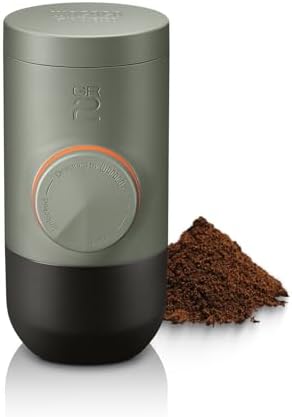
- MANUALLY OPERATED – No electricity, no battery required and the MAX. pressure up to 18 BAR. Add hot water into the water…
- EXTRA COMPACT – The Minipresso GR2 features a large built-in water tank of 80ml, perfect for extracting single espressos…
- ADJUSTABLE BASKET – Experience the ultimate flexibility in espresso brewing with our patented adjustable basket feature….
Best for: espresso, americano, or milk-drink fans who want no outlet.
Overview. The Minipresso GR2 is hand-powered. You fill the tank with hot water, load ground coffee, and pump. CleverHiker’s “best camp espresso” pick was the earlier Minipresso GR, not the GR2, so its testing is a guide, not a verdict on this model.
Verified specs (WACACO):
- Size: 60 × 71 × 125 mm (2.37″ × 2.8″ × 4.92″). Weight: 285 g (10 oz).
- Water tank: 80 ml, for a single shot up to 60 ml. Basket: 8–12 g.
- Maximum pressure: 18 bar (manufacturer rating). Recommended grind: super-fine.
- Hand powered, and it does not heat water. Price on WACACO’s page: $54.90. Warranty: 1 year.
Advantages: no power, a pocket-sized body, and a built-in cup, scoop, funnel, drip tray, and brush.
Limitations: one small shot per cycle. It needs hot water and a fine grind, which usually means a grinder. WACACO says pumping takes roughly 6 to 12 kg of force and that you should rinse parts under running water after each use. That adds up when you are conserving fresh water.
RV suitability. It is great in a tiny kitchen and useless for a crowd. Heat water first, which may itself take a stove or an electric kettle with its own wattage.
Power: none. Cleaning and storage: not dishwasher safe. It stores in its carrying pouch.
Buy it if you want espresso-style drinks off-grid. Skip it if you drink full mugs or hate fiddly cleanup.
How to Choose the Best Coffee Maker for an RV
Know Your RV Power Setup
Shore power, a generator, and a battery-and-inverter system all behave differently. A standard 30-amp RV service can supply up to roughly 3,600 watts in total (30 amps × 120 volts), and that is shared by everything running, including air conditioning. RVing Know How’s guide reviews mostly electric RV coffee makers, if you want mainstream plug-in options. Check each one’s wattage and availability first.
Do not assume any electric coffee maker works on your inverter. Check four numbers:
- The appliance’s rated wattage on its label.
- Your inverter’s continuous rating, not only its peak.
- Your battery capacity and usable energy.
- Everything else that might run at the same time.
Also check surge ratings. Some machines add pumps or electronics that raise momentary demand, and inverters publish separate surge limits.
Estimate Battery Use
Watt-hours = watts × minutes of heating ÷ 60. As an illustration only, a 1,425-watt brewer heating for three minutes uses about 71 watt-hours before inverter losses. Actual heating time was not verified, so check your own. If you want a low-wattage coffee maker for an RV, the lowest-wattage option is a manual brewer, though heating water still takes fuel or electricity. An electric kettle is another heating appliance with its own wattage.
Counter Footprint and Cabinet Clearance
Measure width, depth, and height with lids and handles open. Our guides to small coffee makers for limited counter space and compact coffee makers for small kitchens show the method in detail.
Drinkers, Speed, and Taste
REI notes single-serve brewers get time-consuming for groups, since you brew and clean for each cup. For two people, a 30 oz batch is simpler than two rounds. If you want a strong espresso-style cup, the AeroPress or the GR2 fit better than a pour-over.
Water Supply and Cleaning
In a rig with a small fresh tank, rinse needs matter. Keep grounds out of the sink. REI also advises packing out used grounds when camping.
Durability and Secure Storage
Glass carafes and loose parts can crack or slide. Prefer shatter-resistant parts, nesting designs, and a cabinet where nothing rattles.
Budget and Ongoing Costs
The four manual options run from $10.95 to $54.90 on manufacturer pages, and the K-Mini’s price varies by retailer. Add a kettle, a grinder, and filters if you do not own them. Pods usually cost more per cup than ground coffee, so compare using your own prices. For electric machines under $100, see our best compact coffee makers under $100.
Manual vs. Electric Coffee Makers
| Manual brewers | Electric brewers | |
|---|---|---|
| Convenience | Hands-on every time | Push-button |
| Electricity | None for brewing | Rated wattage matters |
| Portability | Small, light, durable | Heavier, cord and reservoir |
| Capacity | One cup to a few mugs | Varies; compact models often one cup |
| Cleanup | Rinse and dump grounds | Rinse, plus descaling |
Manual brewers still need hot water from a kettle, stove, or other heat source. The coffee maker is small, but the heating step is not free.
Coffee Makers for Different RV Situations
- Solo travelers: AeroPress Go or the Ultralight Java Drip.
- Couples: the 30 fl. oz. JavaDrip, or the AeroPress Go if you brew in turns.
- Families: none of our shortlist is ideal. A larger French press, percolator, or full-size electric drip maker suits a crowd better. REI’s guide covers group-sized camp brewers.
- Weekend campers: the Ultralight Java Drip is cheap enough to try.
- Full-time RV residents: the K-Mini if you have steady hookups, or an AeroPress Go for backup.
- Boondockers: a manual brewer, paired with whatever you already use to heat water.
- RV users with electrical hookups: the K-Mini, after checking your total load.
Practical RV Coffee Tips
- Measure storage space before buying. Include the lid and handle clearance.
- Secure equipment before driving. Use a non-slip mat, padded bin, or strap.
- Empty water reservoirs and loose liquid containers when appropriate.
- Avoid hot appliances on unstable surfaces. Let hot parts cool before stowing.
- Follow manufacturer instructions and your RV’s electrical limits. For any wiring or inverter changes, talk to a qualified RV technician.
Frequently Asked Questions
What is the best compact coffee maker for an RV?
It depends on your power and group size. Our top compact pick is the AeroPress Go. For off-grid or tight budgets, the Ultralight Java Drip. For hookups, the K-Mini is a candidate after you verify its details.
What coffee maker works best when boondocking?
A manual brewer. The AeroPress Go and Ultralight Java Drip need no electricity, only hot water. This is the case for an off-grid coffee maker: it removes the appliance load from your battery.
Can I use a regular coffee maker in an RV?
Often yes, on shore power, if the total load stays within your service. On an inverter, check the appliance’s rated wattage against the inverter’s continuous rating and your battery. Glass carafes are fragile on the road.
How many watts should an RV coffee maker use?
There is no single right number. It depends on the appliance and your RV’s electrical setup. Retail listings show about 1,425 W for the K-Mini, and the inverter’s continuous rating must exceed whatever you run, plus other loads.
Are manual coffee makers better for camping?
Often, yes, for boondocking and tight spaces. They trade convenience for no power draw. If electricity is your constraint, a manual coffee maker for camping is the safer bet.
What is the smallest practical coffee maker for a camper?
The Ultralight Java Drip is the smallest here at 4.2″ × 4.2″ × 0.5″, but you need a mug and hot water. The AeroPress Go is the smallest self-contained option.
How do I keep a coffee maker secure while traveling?
Empty the water, remove loose parts, and stow it in a padded cabinet, bin, or strapped spot. Nesting designs help.
Is a single-serve coffee maker worth it for RV life?
A single-serve coffee maker for an RV is worth it if you have steady hookups and value speed. It is less attractive for battery-only camping, groups, or tight budgets.
Final Verdict
- Most travelers with small kitchens: AeroPress Go.
- Off-grid or lowest cost: GSI Ultralight Java Drip.
- Couples who want a shared batch: GSI 30 fl. oz. JavaDrip, after weighing the limited evidence.
- Hookup campers who want push-button coffee: Keurig K-Mini, once you verify the version and your power.
- Espresso-style drinks without power: WACACO Minipresso GR2.
The right choice fits your counter and your electrical system, not just the smallest advertised footprint.